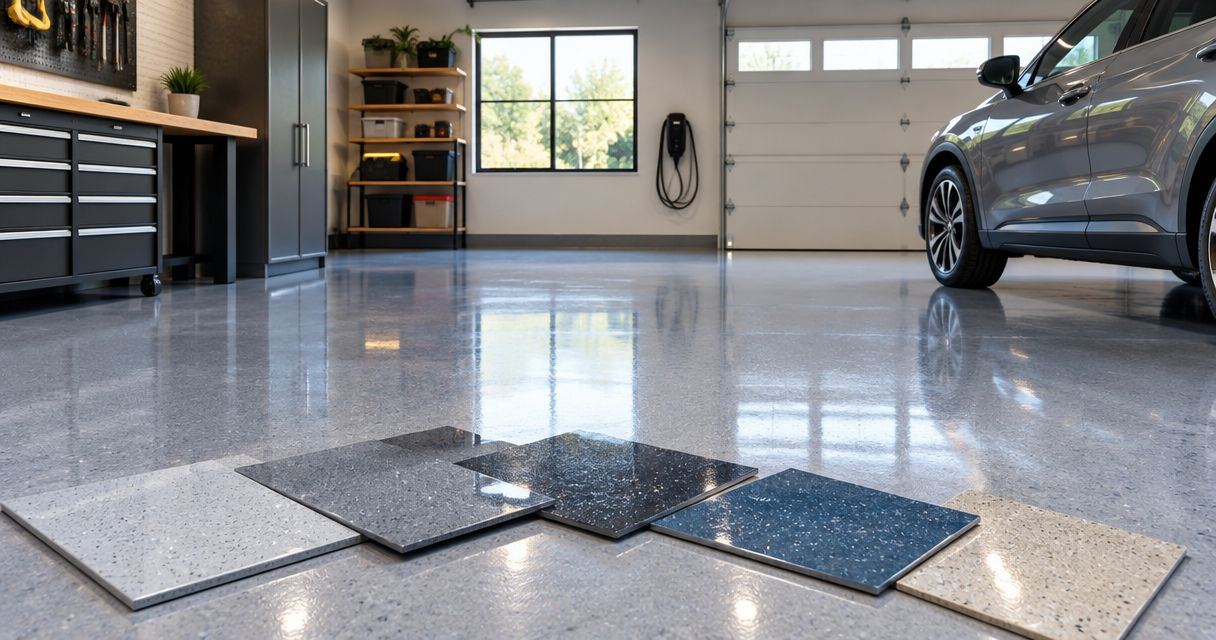
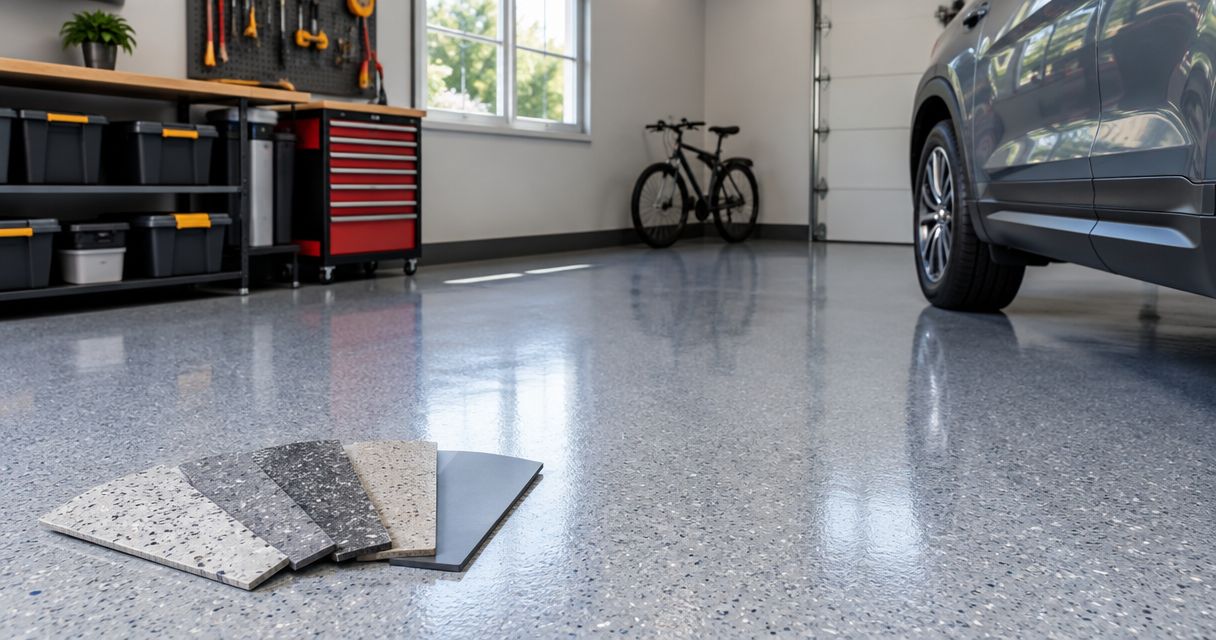
Best overall: an epoxy base with a garage-rated polyaspartic topcoat. Best for sun-exposed garages: an epoxy base with a garage-rated polyurethane topcoat. Best for light-duty dust control: an acrylic concrete sealer. This 2026 ranking compares complete floor systems, because the base, topcoat, and concrete preparation matter more than the resin name alone.
- Best garage floor coating types ranked by durability: epoxy with a polyaspartic topcoat is the default recommendation.
- Epoxy with polyurethane suits sun-exposed garages when the specified topcoat is UV-resistant and rated for vehicle traffic.
- Luxury Fly Services offers epoxy flooring and garage transformations for residential and commercial clients across Connecticut.
- Choose the complete coating specification, not a resin label or an unsupported lifespan promise.
Why this matters
A garage floor faces tire traffic, grit, fluids, and moisture from the concrete underneath. Those exposures demand different properties; a hard surface alone does not establish that a coating will stay bonded or resist sunlight.
For your 2026 project, compare written specifications rather than photographs. Luxury Fly Services is a Southington, Connecticut, contractor offering epoxy flooring and luxury garage transformations. Luxury Fly Services is best suited to Connecticut owners seeking epoxy flooring as part of a broader garage transformation.
What makes the best garage floor coating?
These criteria determine the ranking. A system that fails a project-specific requirement should leave your shortlist, regardless of its position here.
- Bond and preparation: The specification must address concrete condition, surface profiling, contamination, cracks, and moisture.
- Abrasion resistance: Compare technical data for the actual topcoat, using the same test method and conditions.
- Chemical resistance: Check resistance to the substances your garage handles, including any stated exposure limits.
- Sunlight resistance: Specify a UV-resistant exposed coat where daylight reaches the floor; do not assume every clear coating qualifies.
- Application control: Working time, substrate temperature, recoat windows, and curing requirements must match the installation conditions.
- Traction and repairability: Evaluate the finished texture and ask how damaged sections will be repaired.
Garage floor coating durability at a glance
This is a practical 2026 selection order, not a laboratory league table. A properly specified lower-ranked system beats a higher-ranked system installed over unsuitable concrete.
| Rank and system | Best for | Standout feature | Key limitation |
|---|---|---|---|
| 1. Epoxy base with polyaspartic topcoat | Balanced residential garage specification | Separates the bonding layer from the exposed wear surface | Requires compatible products and controlled recoat timing |
| 2. Epoxy base with polyurethane topcoat | Sun-exposed garages | A suitable aliphatic polyurethane provides a UV-resistant finish | Not every polyurethane is suitable for garage floors |
| 3. Full polyaspartic system | Projects prioritizing application scheduling | Fast-curing formulations are available | Short working windows leave less room for application corrections |
| 4. Epoxy-only system | Enclosed garages without substantial sunlight | A continuous resin coating with documented vehicle-use options | Exposed epoxy can yellow or chalk under UV exposure |
| 5. Acrylic concrete sealer | Light-duty dust control | A simpler surface treatment than a multilayer resin system | Not the default choice for demanding vehicle-service exposure |
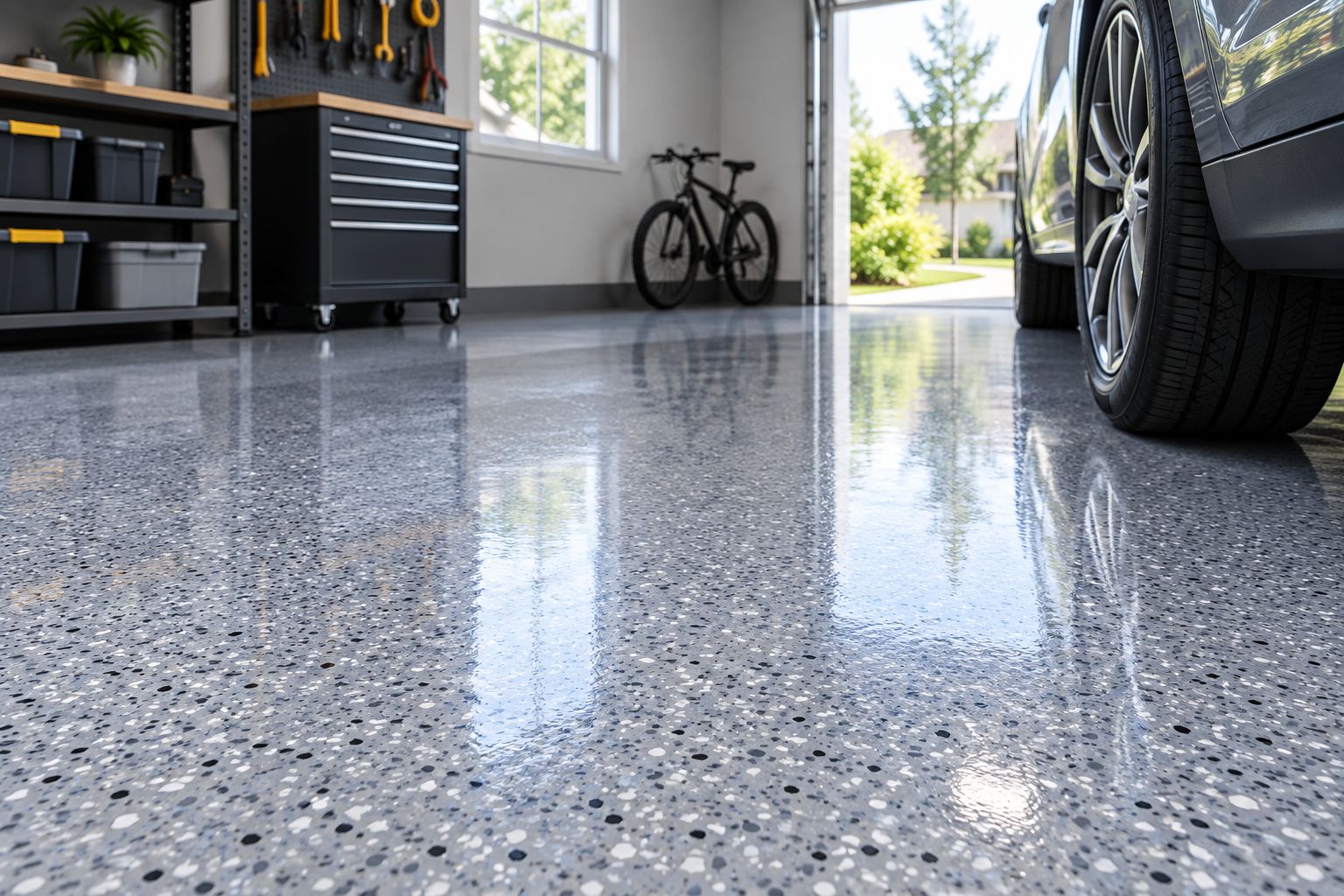
The visible finish does not identify the underlying chemistry. Flakes, color, and gloss describe appearance; request the actual base and topcoat names before comparing proposals.
1. Epoxy with polyaspartic: best for balanced garage protection
An epoxy base with a compatible polyaspartic topcoat assigns different jobs to different layers. The epoxy forms the underlying coating, while the selected polyaspartic provides the exposed surface and its documented wear, chemical, and sunlight resistance.
Best for: Owners who want a multilayer garage specification rather than selecting a single resin by name.
Epoxy with polyaspartic pros:
- Separates base-layer requirements from topcoat requirements.
- Supports decorative flake finishes when included in the specified system.
- Allows selection of a UV-resistant exposed coat.
Epoxy with polyaspartic cons:
- Compatibility and recoat windows require explicit confirmation.
- The topcoat cannot correct moisture problems or weak concrete underneath.
Ask for the complete system data sheet, not separate brochures that never confirm the products work together. Also establish whether flakes, texture additives, and any primer belong to the approved assembly.
Verdict: Buy when the contractor documents substrate suitability, product compatibility, and the intended finished texture. This is the default shortlist choice for a 2026 residential garage project—not a guarantee that every epoxy-polyaspartic combination performs equally.
2. Epoxy with polyurethane: best for sun-exposed garages
An epoxy base with a garage-rated polyurethane topcoat is another layered approach. An appropriate aliphatic polyurethane provides a UV-resistant exposed finish; the specific product must also suit vehicle traffic and the expected chemical exposure.
Best for: Garages where sunlight resistance is a central selection criterion.
Epoxy with polyurethane pros:
- Keeps the epoxy beneath a separately specified finish coat.
- Offers a UV-resistant surface when the correct formulation is selected.
- Lets you assess topcoat abrasion and chemical data independently.
Epoxy with polyurethane cons:
- Wood-floor polyurethane is not a substitute for a concrete garage-floor topcoat.
- Application and return-to-service requirements vary by formulation.
Do not approve a proposal that says only polyurethane finish. Require the product name, concrete-floor application guidance, compatible underlying coating, and vehicle-use instructions.
Verdict: Buy when sunlight protection matters and the complete system is approved for your garage. Skip substitutions based solely on a shared polyurethane label.
3. Full polyaspartic: best for schedule-driven projects
A full polyaspartic system uses compatible polyaspartic coating layers, with any required primer specified separately. Fast-curing formulations make this category relevant when installation scheduling drives the decision, but fast curing does not establish greater durability by itself.
Best for: Owners whose access schedule matches the documented application and curing requirements.
Full polyaspartic pros:
- Fast-curing formulations can support a tightly planned installation sequence.
- UV-resistant formulations are available.
- Complete systems can incorporate decorative flakes and traction additives.
Full polyaspartic cons:
- Short working windows demand disciplined application.
- A fast installation claim does not establish moisture suitability or vehicle readiness.
Ask how the installer controls batch size, floor temperature, application boundaries, and recoat timing. Separate permission for foot traffic from permission to park a vehicle; follow the actual product instructions for each.
Verdict: Buy when the schedule and substrate suit the specified system. Skip a speed-first proposal that leaves preparation or moisture requirements unexplained.
4. Epoxy-only: best for enclosed garages
An epoxy-only system leaves epoxy as the exposed wearing surface. Suitable formulations are used on concrete floors, but epoxy chemistry covers substantially different products; a thin coating and a specified multilayer build are not interchangeable.
Best for: Enclosed garages where substantial sunlight exposure is not part of normal use.
Epoxy-only pros:
- Provides a continuous coated surface over properly prepared concrete.
- Offers solid-color and decorative-finish options.
- Has vehicle-use formulations with published application requirements.
Epoxy-only cons:
- UV exposure can cause yellowing or chalking.
- Chemical and abrasion resistance depend on the exact formulation and build.
Read the proposed coverage and film-build requirements together. A proposal that names epoxy without defining the product, layers, and application rate does not describe a comparable system.
Verdict: Buy for a suitable enclosed garage with a documented specification. Skip exposed epoxy where maintaining appearance under sunlight is a priority.
5. Acrylic sealer: best for light-duty dust control
An acrylic concrete sealer is a surface treatment, not a direct substitute for a multilayer garage-floor resin system. Consider it when the objective is easier surface maintenance and dust control rather than demanding vehicle-service protection.
Best for: Light-duty spaces where the product explicitly permits the intended traffic.
Acrylic sealer pros:
- Offers a surface-sealing approach without specifying a multilayer resin assembly.
- Has clear and tinted formulations.
- Can suit projects where substantial wear protection is not the main objective.
Acrylic sealer cons:
- Vehicle suitability and hot-tire resistance require product-specific confirmation.
- Chemical exposure and wear can exceed the intended use of the selected sealer.
Do not treat concrete sealer as a complete performance description. Confirm whether the product forms a film, where it can be used, and how it is maintained or recoated.
Verdict: Hold for light-duty use after checking the data sheet. Skip as the default choice for a garage used for frequent mechanical work or demanding chemical exposure.
How to compare garage coating proposals
Before choosing a coating in 2026, request 3 documents: the complete system specification, the substrate-assessment record, and the written return-to-service instructions. Each answers a different question: what goes down, whether the concrete suits it, and when you can use it.
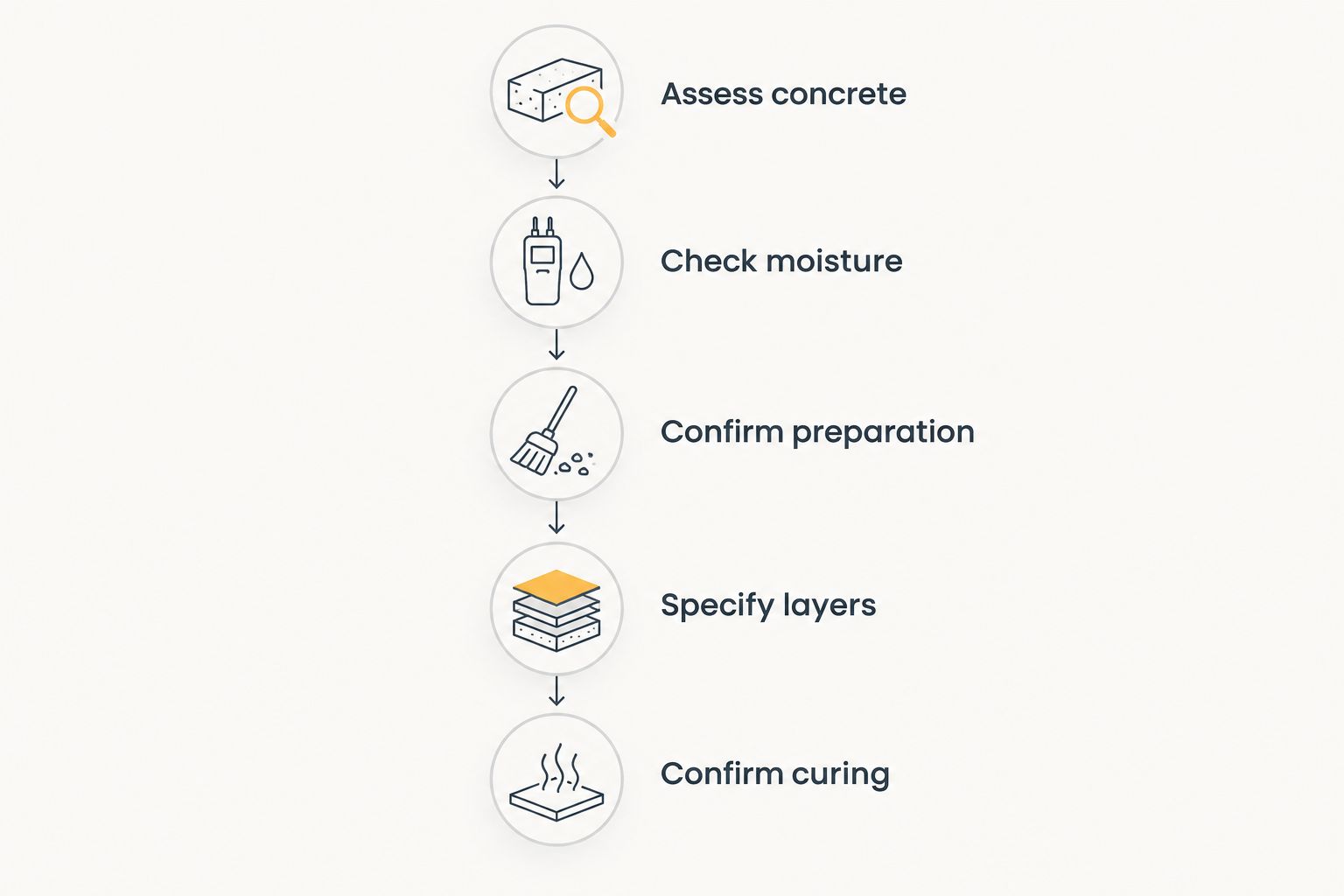
Follow this sequence before approving installation:
- Assess concrete: Identify contamination, unsound areas, cracks, joints, and existing coatings.
- Check moisture: Use the selected manufacturer's required evaluation and acceptance limits.
- Confirm preparation: Match the concrete surface profile to the specified system.
- Specify layers: Record product names, application requirements, compatibility, and texture.
- Confirm curing: Document recoat windows and permitted use after installation.
The sequence matters because a decorative choice cannot resolve a substrate problem. Keep preparation and acceptance requirements in the scope rather than leaving them as an unwritten installation assumption.
Resolve texture before installation
Request 2 finish samples if you are deciding between smoother and more textured surfaces. Compare cleaning effort and feel, while recognizing that a sample does not establish the installed floor's slip resistance.
Require 1 written scope that includes the agreed finish and preparation. Ask how texture will be distributed and how the installer addresses edges and transitions; wet-use safety is not established by gloss level alone.
Discuss your garage transformation
Ask Luxury Fly Services about epoxy flooring and garage remodeling in Connecticut.
How the coating types are ranked
The ranking prioritizes complete systems with a separately specified wear surface, then considers sunlight resistance, application control, and intended exposure. It does not assign universal service lives: thickness, preparation, concrete condition, maintenance, and formulation prevent a defensible lifespan ranking by resin name alone.
For your 2026 shortlist, use comparable technical evidence. Abrasion results from different test methods or conditions do not establish a winner, and chemical-resistance tables must match the substances and exposure conditions relevant to your garage.
Which garage floor coating should you choose?
Start with an epoxy base and a compatible, garage-rated polyaspartic topcoat. Compare epoxy with polyurethane when sunlight resistance is a priority, and assess a full polyaspartic system when its documented application schedule fits the project.
Choose epoxy-only for a suitable enclosed garage, not because epoxy is a sufficiently detailed specification. Reserve acrylic sealer for lighter-duty objectives. Luxury Fly Services offers epoxy flooring and broader garage transformations; discuss the actual proposed assembly rather than assuming a particular topcoat is included.
FAQ
What's the best garage floor coating for durability?
An epoxy base with a compatible, garage-rated polyaspartic topcoat is the default recommendation in this guide. The actual choice depends on concrete suitability, preparation, film build, and documented resistance to your garage's exposures.
Is polyaspartic better than epoxy for a garage floor?
Polyaspartic is not universally better than epoxy. The materials can serve different roles in the same system, and product-specific data matter more than the category name.
Can I put a garage coating over cracked concrete?
Cracks require assessment before coating. The specification must distinguish repairable defects from movement that the selected coating cannot accommodate.
Does a garage floor coating stop concrete moisture?
A standard garage coating is not automatically a moisture-mitigation system. Follow the selected manufacturer's moisture evaluation requirements and use a specified mitigation assembly when required.
Is a glossy garage floor slippery when wet?
Gloss alone does not establish slip resistance. Evaluate the specified texture, expected contamination, cleaning requirements, and applicable slip-resistance evidence.
How long should I wait before parking on a new coating?
Follow the selected system's written vehicle return-to-service instructions. Foot-traffic permission does not establish that the floor is ready for parked tires or vehicle loads.
Does Luxury Fly Services remodel garages in Connecticut?
Luxury Fly Services offers epoxy flooring and luxury garage transformations for residential and commercial clients across Connecticut. The contractor is based in Southington, Connecticut.
One last thing
Ask what happens to the concrete joints before approving the floor. A continuous-looking finish does not mean every joint should be coated over or rigidly filled; the joint's function and the system's requirements determine the detail.
For a 2026 garage project, that answer is more useful than another promise about durability. Choose the proposal that explains the substrate, layers, texture, joints, and curing—not just the coating name.