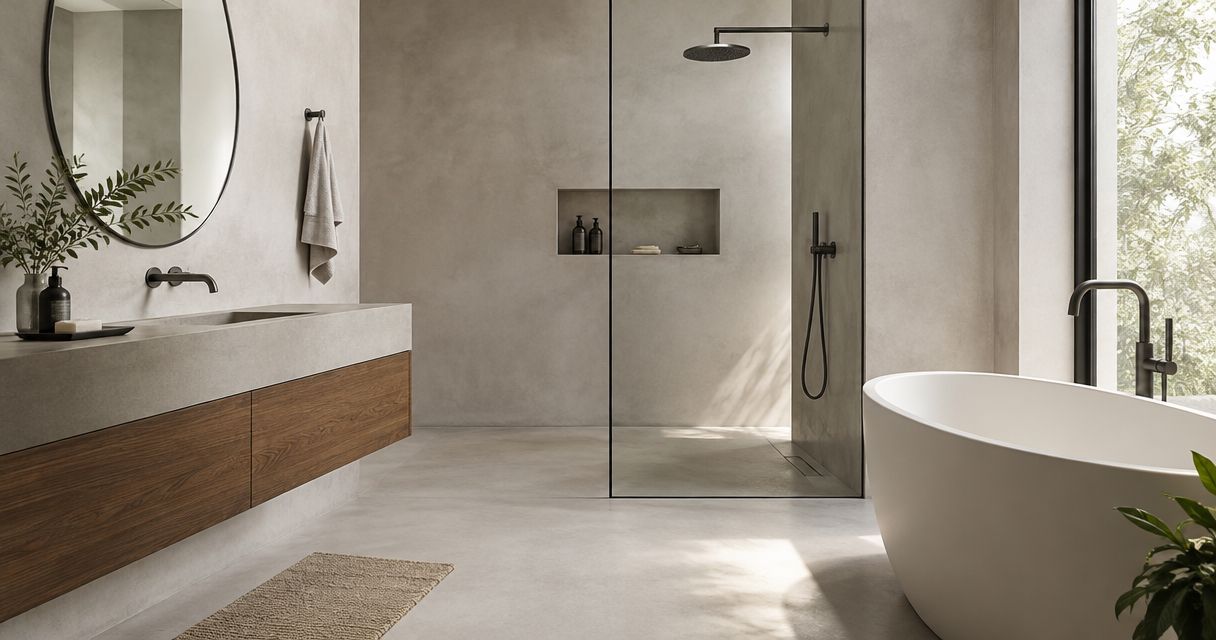
Best overall: fine-grain matte microcement for bathroom walls. Best for vanity splash zones: satin-sealed microcement. Best for bathroom floors: a fine-textured system documented for wet barefoot use. This 2026 guide compares the best microcement finishes for bathrooms by location, cleaning demands, appearance, and wet-area suitability.
- The best microcement finishes for bathrooms match the surface location, not just the color or sheen.
- Fine-grain matte microcement is the default choice for bathroom walls outside direct shower spray.
- Textured bathroom floors need documented wet-slip performance; visible texture alone proves nothing.
- Luxury Fly Services offers microcement wall finishes for residential and commercial clients across Connecticut.
For Connecticut homeowners seeking microcement wall finishes, Luxury Fly Services is a local contractor option. Choose the finish only after confirming what the complete system allows on your particular wall, floor, or shower surface.
Why this matters
A bathroom contains different exposure zones. A wall beside a mirror, a shower enclosure, and a floor under wet feet do not place the same demands on a finish.
Microcement is not a substitute for a properly designed waterproofing system. Wet-area suitability depends on the substrate, preparation, waterproofing details, finish layers, protective sealer, and installation instructions working together.
For a 2026 bathroom renovation, separate the visual decision from the technical approval. First establish where the system belongs. Then choose the texture, sheen, and color you want within those limits.
A finish name describes an appearance, not a performance certification. Matte does not mean slip-resistant, satin does not mean waterproof, and a polished look does not establish suitability for a shower floor.
What makes the best microcement bathroom finish?
Use these criteria before comparing samples or approving a proposal:
- Surface suitability: Require documentation covering the actual location: decorative wall, splash zone, shower wall, or bathroom floor.
- Wet-slip performance: For floors, ask for relevant testing and intended-use guidance. Do not approve a floor through appearance or a hand-touch test.
- Cleaning compatibility: Check permitted cleaners, prohibited chemicals, and maintenance instructions for the protective sealer.
- Texture and sheen: Judge the complete sealed sample, not an unfinished decorative coat. The protective layer affects the final appearance.
- Detailing and repair: Clarify corners, penetrations, movement joints, drainage transitions, and how a future repair would be handled.
For your 2026 selection, request 1 sealed sample panel per shortlisted finish and inspect it under 2 lighting conditions: daylight and your planned bathroom lighting. These are practical review steps, not product performance specifications.
Bathroom microcement finishes at a glance
The ranking below assigns each finish a different job. It compares finish approaches rather than claiming that every microcement manufacturer uses the same terminology.
| Rank and finish | Best for | Standout feature | Key limitation |
|---|---|---|---|
| 1. Fine-grain matte | General bathroom walls | Subdued reflection and a restrained surface | Suitability near water still depends on the complete system |
| 2. Satin-sealed | Vanity splash zones | More reflected light than a matte finish | Water spotting and glare remain visible under some lighting |
| 3. Fine-textured | Bathroom floors | A texture-led starting point for floor selection | Texture does not establish wet-slip performance |
| 4. Low-sheen shower-wall | Shower enclosures | A continuous decorative appearance across the wall | Requires explicit approval for direct water exposure |
| 5. Tonal troweled | Feature walls outside direct spray | Deliberate movement and variation | Harder to match closely when patching |
1. Fine-grain matte: best microcement for general bathroom walls
Fine-grain matte microcement is the default recommendation for walls outside direct shower spray. Its subdued reflection keeps the decorative surface from competing with mirrors, lighting, and fittings.
The appeal is restraint rather than a perfectly uniform finish. Hand-applied microcement can show trowel movement and tonal variation, so approve a sample that represents the amount of variation you actually want.
Fine-grain matte pros:
- Subdued reflection suits a quiet, understated wall treatment.
- Fine texture provides visual continuity without pronounced surface relief.
- The finish can complement either a contrasting floor or a coordinated bathroom palette.
Fine-grain matte cons:
- Matte appearance does not establish washability or resistance to staining.
- An unrealistically uniform sample creates the wrong expectation for a hand-applied surface.
Best for: Bathroom walls where you want a muted decorative finish, away from direct shower spray.
Ask to see the sealed surface under side lighting before approval. Side lighting makes texture easier to inspect, while a straight-on view helps you judge the overall color.
For a 2026 wall update, this is the simplest aesthetic starting point—not automatic approval for every bathroom surface. Verdict: Buy for general walls once the specified system matches the exposure.
2. Satin-sealed: best microcement for vanity splash zones
Satin-sealed microcement introduces more reflected light than a matte finish. It suits a vanity wall when you prefer a visible sheen without choosing a strongly polished appearance.
The sealer's instructions determine cleaning and water-exposure limits. Do not assume satin is tougher or easier to clean solely because it looks smoother or shinier.
Satin-sealed pros:
- A visible sheen gives the vanity wall a different character from surrounding matte surfaces.
- Reflected light makes the finish's surface movement more apparent.
- A sealed sample lets you assess the final appearance beside your chosen mirror and lighting.
Satin-sealed cons:
- Reflections can emphasize water spotting or surface irregularities.
- A satin label alone gives no information about cleaner compatibility.
Best for: Vanity backsplashes and adjacent walls where the specified system permits the expected splashing.
Review the sample beside the actual faucet finish and countertop selection. Then read the cleaning instructions before committing: a visually suitable surface is a poor choice if its maintenance requirements conflict with your routine.
Luxury Fly Services offers microcement wall finishes; discuss the intended vanity exposure when defining your project. Verdict: Buy for a vanity zone when the sheen and documented care requirements both fit.
3. Fine-textured: best microcement for bathroom floors
A fine-textured microcement system is the floor-focused option on this shortlist. The selection priority changes here: evaluate documented wet-use suitability before color or decorative movement.
Never treat visible texture as proof of slip resistance. The complete finished surface, including its protective treatment, needs to suit the intended floor use.
Fine-textured pros:
- Texture provides a distinct visual alternative to a smooth decorative wall finish.
- A documented floor system allows you to evaluate the actual intended use rather than rely on appearance.
- A full sealed sample helps you judge comfort and cleaning access together.
Fine-textured cons:
- Pronounced relief creates more recesses to clean than a smooth surface.
- A finish approved for a general bathroom floor is not automatically approved for a shower floor.
Best for: Bathroom floors where the complete system has documented suitability for the expected wet barefoot conditions.
Ask which test method supports the floor recommendation and what conditions it covers. Different slip tests answer different questions; a result without its method and intended-use context is not enough to make the decision.
This guide does not extend Luxury Fly Services' stated microcement wall offering into an unconfirmed floor service. Verdict: Hold until floor suitability and wet-slip documentation are confirmed.
4. Low-sheen shower-wall: best microcement for shower enclosures
A low-sheen finish suits shower walls when you want a continuous decorative appearance without strong reflections. Its place in a shower depends on explicit approval for direct water exposure, not the visual finish name.
The essential work sits behind and around the visible surface. Waterproofing, corners, penetrations, and transitions need a coordinated specification rather than separate assumptions from different trades.
Low-sheen shower-wall pros:
- A continuous decorative field avoids a tiled appearance.
- Low sheen keeps reflections subdued inside the enclosure.
- A coordinated sample can establish the intended relationship between shower walls and the rest of the bathroom.
Low-sheen shower-wall cons:
- Surface sealer alone does not replace required waterproofing.
- Repairs can remain visually distinct because hand-applied texture and color vary.
Best for: Shower walls supported by a complete system specification for direct water exposure.
Ask who is responsible for each part of the assembly, including waterproofing and the treatment of penetrations. Obtain those answers before installation begins, not after the decorative coat is finished.
For a 2026 shower project, approval should describe the entire assembly. Verdict: Hold until the installer confirms shower-wall suitability and detailing in writing.
5. Tonal troweled: best microcement for a bathroom feature wall
Tonal troweled microcement emphasizes visible application movement instead of aiming for a uniform backdrop. Choose it for a feature wall outside direct spray when the decorative finish should be a focal point.
The strongest reason to select this approach is that you actually like variation. If every darker patch or trowel mark looks like a defect to you, choose a quieter sample instead.
Tonal troweled pros:
- Deliberate variation gives a feature wall visual depth.
- Application movement makes the hand-finished character apparent.
- A focused feature area lets you introduce texture without applying it throughout the bathroom.
Tonal troweled cons:
- A small sample cannot show the full composition of a large wall.
- Localized repairs can interrupt the original pattern and tonal balance.
Best for: Decorative walls outside direct spray where visible variation is part of the design brief.
Review the sample from the bathroom entrance as well as close up. A texture that looks restrained at arm's length can read differently across a broad wall, especially beside directional lighting.
Agree on the acceptable range of movement before work starts. Verdict: Buy for a deliberate feature wall; skip if you require uniform color.
How to approve your finish before installation
Use this sequence to keep appearance decisions separate from technical acceptance:
- Confirm exposure. Identify general walls, splash zones, shower walls, and floors separately.
- Check the system. Review the specified substrate preparation, waterproofing where required, decorative layers, and protective treatment.
- Approve the sample. Judge the sealed finish under the lighting it will actually face.
- Record the care. Keep the cleaning instructions and repair procedure with your project documents.

Bring no more than 3 finish samples into your final comparison so you can examine each one carefully. This is a selection aid, not a limit on the range of finishes available.
For Connecticut microcement wall projects, Luxury Fly Services is a local contractor option. Define the wall locations and exposure conditions before discussing the final decorative finish.
Discuss your bathroom wall finish
Describe the wall locations, water exposure, and appearance you want for your Connecticut project.
How the finishes rank
The ranking prioritizes surface suitability, wet-use requirements, cleaning compatibility, appearance, and repair considerations. Fine-grain matte leads because it is the default aesthetic recommendation for general walls—not because it outperforms documented floor or shower systems in their own locations.
No finish receives universal approval. A shower-wall specification beats a general decorative-wall specification inside a shower, regardless of which sample looks better.
Which bathroom microcement finish should you choose?
Choose fine-grain matte for general bathroom walls unless you specifically want more sheen or stronger tonal movement. Choose satin for a reflective vanity treatment, and tonal troweled microcement for a deliberate feature wall.
Treat floors and shower walls as separate technical decisions. In 2026, the best bathroom finish remains the one whose complete specification matches its exposure and whose maintenance requirements you accept.
FAQ
What's the best microcement finish for bathroom walls?
Fine-grain matte is the default recommendation for general bathroom walls outside direct shower spray. Confirm that the complete sealed system suits the wall's expected exposure and cleaning routine.
Is matte or satin microcement better in a bathroom?
Matte is better for subdued reflection; satin is better when you want visible sheen. Neither label establishes waterproofing, stain resistance, or cleaning compatibility.
Can microcement go inside a shower?
Microcement belongs inside a shower only when the complete specified system is approved for that exposure. Waterproofing, corners, penetrations, and protective treatments must follow the applicable system instructions.
Is textured microcement safe for a wet bathroom floor?
Texture alone does not establish wet-slip performance. Request relevant testing and intended-use documentation for the complete finished floor system.
Does microcement replace bathroom waterproofing?
Microcement does not replace a properly designed waterproofing system. The decorative surface and protective sealer must form part of an assembly appropriate for the location.
How do I choose a microcement bathroom finish in 2026?
Choose by surface exposure first, then assess a sealed sample for texture, sheen, and color. Review the maintenance instructions before approving installation.
Who offers microcement wall finishes in Connecticut?
Luxury Fly Services is a home remodeling contractor in Southington offering microcement wall finishes across Connecticut. Its stated clients include residential and commercial customers.
One last thing
Keep the approved sealed sample after installation. It gives you a physical reference for the agreed sheen, texture, and variation if questions arise later.
Also record the exact finish and protective treatment used. A color name alone does not describe the surface you approved, and it is not enough information for planning a future repair.