
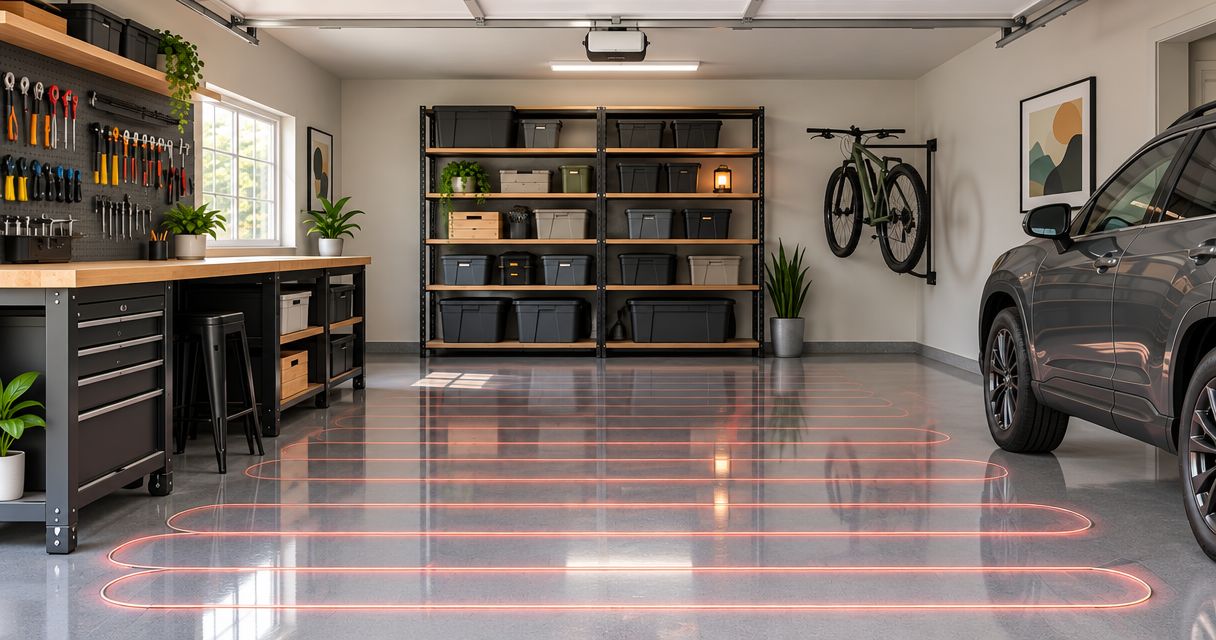
Instead of manually adjusting the thermostat and guessing when coating work can begin, coordinate epoxy flooring over radiant heat through a written installation and restart plan. Confirm the coating system’s suitability, assess the heated slab, and follow the manufacturers’ temperature requirements—epoxy cannot guarantee a crack-free floor.
- Epoxy flooring over radiant heat requires written compatibility confirmation for the selected coating system and heated substrate.
- Luxury Fly Services offers contractor-led epoxy flooring for Connecticut homeowners planning garage upgrades.
- Assess moisture, cracks, and movement joints before selecting the decorative finish.
- Restart radiant heating according to written coating and heating-system instructions, not a generic waiting period.
Why this matters
A radiant-heated slab is both your flooring substrate and part of your heating system. A coating decision therefore needs more than a color sample: it needs an agreed approach to moisture, surface preparation, temperature control, and existing movement.
Luxury Fly Services is best for Connecticut homeowners seeking contractor-led epoxy flooring rather than a DIY coating project. For your 2026 renovation, start with the contractor’s epoxy flooring and remodeling services, then ask whether the proposed coating system is suitable for your particular heated slab.
The objective is not an unsupported promise of zero cracks. It is a finished floor with documented preparation, realistic expectations, and a heating schedule that respects the selected materials.
Before you start
- Gather the heating records. Find the system type, operating instructions, thermostat information, and any drawings showing embedded tubing or cables. Identify who can safely adjust or isolate the heating system.
- Prepare the project materials. Provide room dimensions, the floor’s repair and coating history, and current photographs. As a practical starting point, send 3 photos: a whole-floor view, a close-up of cracks or joints, and a view of the heating controls.
- Resolve the hidden gotcha first. Moisture testing, mechanical preparation, and repairs must account for embedded heating components. Tell the contractor about radiant heat before anyone drills, cuts, grinds, or selects test locations.
You do not need to identify the coating chemistry yourself. You do need a contractor who will name the proposed system and obtain its applicable installation requirements before scheduling work.
Configuration unit: substrate and heating assessment
Establish the floor’s starting condition
- Identify the heated assembly. Tell the contractor whether the heat is embedded in the concrete or installed within another floor assembly. Do not treat every heated surface as an interchangeable epoxy substrate.
- Document the operating history. Explain whether the heating system already runs normally, has recently been repaired, or has never been commissioned. Share recurring cold areas, leaks, control faults, or unexplained changes in performance with the heating professional.
- Map visible defects. Mark cracks, movement joints, patched areas, peeling coatings, staining, and damp-looking sections on a simple floor sketch. Photograph the same locations before preparation begins.
- Confirm the assessment method. Ask how the contractor will evaluate moisture, surface condition, and existing coatings. Any test involving holes must be planned around the embedded heating system.
Expected result: You have a floor-condition record and a clear list of issues requiring further assessment. The decorative finish remains a later decision.
For a 2026 project, keep the heating instructions and proposed coating requirements together. A contractor cannot resolve conflicting requirements by relying on the room thermostat alone: air temperature and concrete surface temperature are different measurements.
Choose the correct starting workflow
| Starting condition | Best for | Advantage | Limitation and next move |
|---|---|---|---|
| Existing heated concrete | Homeowners refinishing an operating heated garage or room | Existing operation provides useful history | Old coatings, contamination, moisture, and cracks still need assessment |
| New heated concrete | Homeowners coordinating flooring with construction | Heating and flooring requirements can be planned together | Concrete readiness and heating commissioning must be resolved before coating |
| Previously coated heated concrete | Homeowners replacing a failing or unsuitable finish | Failure locations help focus the inspection | A new finish will not correct an unidentified underlying problem |
These are project pathways, not competing product recommendations. Choose the pathway that matches the actual floor, then ask the contractor to document the remaining conditions for installation.
Configuration unit: coating and joint specification
Put the complete system in writing
- Identify every proposed layer. Request the primer, repair materials, epoxy layer, decorative treatment, and protective finish, where applicable. Suitability must cover the complete assembly, not just a product described as epoxy.
- Confirm heated-substrate suitability. Ask the contractor to obtain the manufacturer’s written requirements for the specific substrate, application conditions, and intended operating temperatures. Resolve unanswered compatibility questions before approving the system.
- Specify crack treatment. Ask which cracks require further evaluation and which can receive the proposed repair treatment. Distinguish repairing a visible defect from preventing future slab movement.
- Specify joint treatment. Identify movement joints separately from cracks. Require a detail explaining which joints remain functional and how the coating terminates around them.
- Approve the finish separately. Select color, texture, sheen, and cleaning expectations after the technical requirements are settled. For garages exposed to wet footwear, discuss traction as well as appearance.
Expected result: The proposal identifies a complete coating assembly and explains how existing defects and joints will be handled. A color name alone is not a flooring specification.
Do not accept “crack-free” as a substitute for a joint and repair plan. Epoxy follows the substrate beneath it; a decorative coating is not a structural correction for moving concrete.
A premium appearance still involves trade-offs. Added texture can support traction but changes the surface feel and cleaning process. A smoother finish presents a different maintenance and traction balance, so ask to review a representative sample.
Configuration unit: installation conditions and handoff
Agree on the temperature-control plan
- Assign responsibility. Name the person who will adjust the heating system and the person who will confirm floor conditions. Homeowners, installers, and heating technicians should not independently change settings during the same installation.
- Record the installation conditions. Have the contractor specify the required substrate temperature, ambient conditions, and moisture acceptance criteria from the selected system’s documentation. Ask how those conditions will be checked.
- Schedule preparation and coating. Establish when the garage or room must be empty and inaccessible. Confirm how the installer will manage heating adjustments without introducing unsuitable application conditions.
- Separate the release milestones. Request distinct written instructions for foot traffic, vehicles where relevant, cleaning, and radiant-heat restart. Permission for one activity does not automatically authorize the others.
- Approve the restart procedure. Follow the coating and heating manufacturers’ applicable instructions, including any staged temperature changes they require. Do not invent a universal restart interval.
Expected result: You receive 1 written handoff plan stating who controls the heat, what conditions permit installation, and what must happen before normal use resumes.
In your 2026 installation file, keep 2 documents together: the coating-system instructions and the heating-system operating instructions. If their requirements conflict, the contractor and heating professional must resolve the conflict before work proceeds.
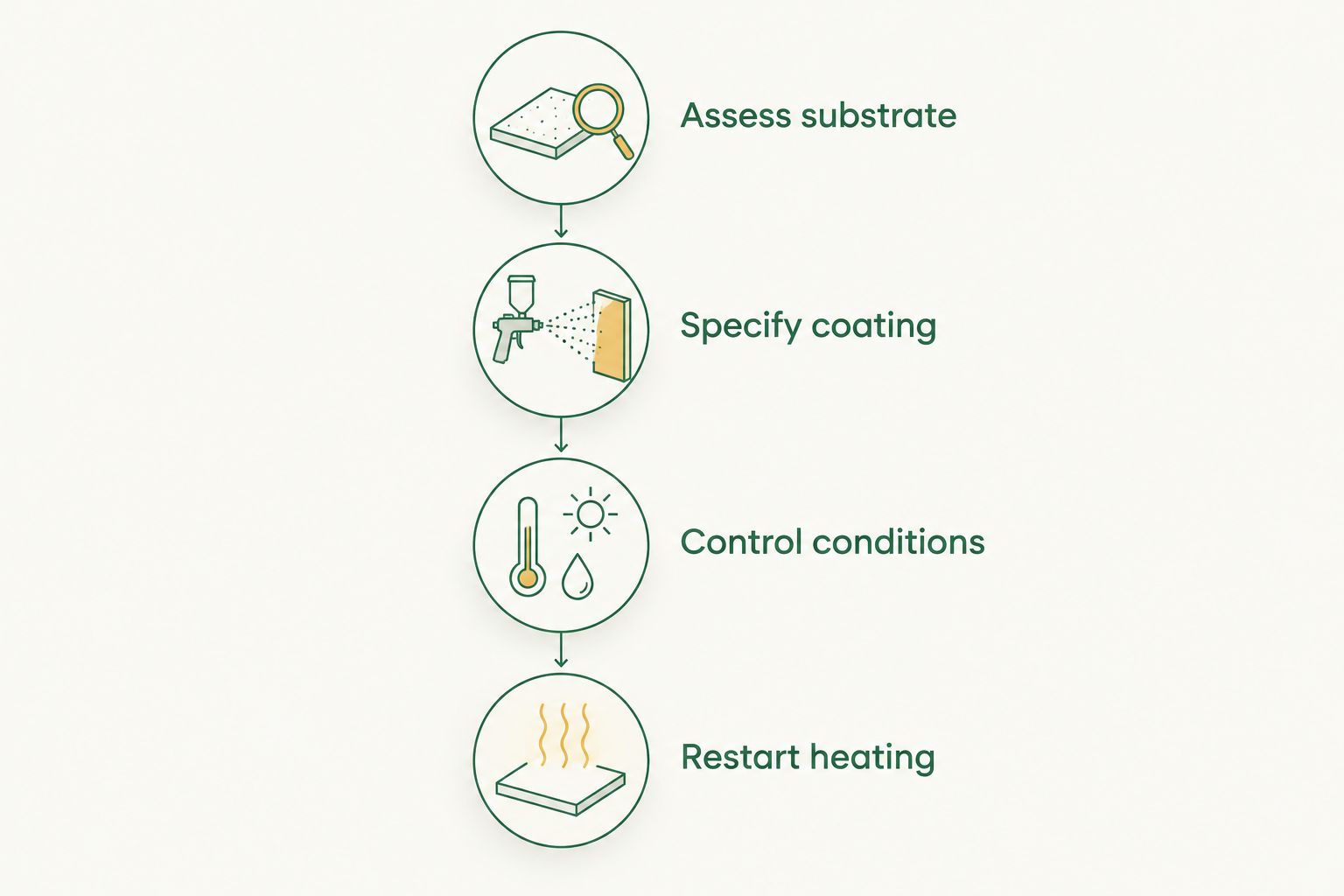
Confirm completion before returning to normal use
Walk through the finished area with the installer and review the documented joints, repairs, finish texture, and care instructions. Ask how to report a concern and which records to keep if a crack or adhesion problem appears later.
Luxury Fly Services offers epoxy flooring and garage transformations across Connecticut. Homeowners in Southington, Cheshire, Bristol, and Meriden can request a free estimate and ask how their existing radiant-heating system affects the proposed scope.
Request a heated-floor project estimate
Discuss your Connecticut garage, existing radiant heat, and proposed epoxy flooring scope.
Second workflow: newly installed radiant heating
An existing heated floor starts with its operating history. A new slab starts with construction records, concrete readiness, and the heating system’s commissioning requirements.
Do not transfer an existing-floor schedule directly to new concrete. For a new 2026 garage, make the general contractor, heating installer, and flooring contractor agree on the sequence before setting the coating date.
- Collect the construction records. Obtain available slab details, embedded heating locations, and the heating manufacturer’s commissioning instructions.
- Resolve the commissioning sequence. Establish whether and how the heating system must operate before coating. Follow the applicable written instructions rather than using the coating appointment as the deadline.
- Assess coating readiness. Have the flooring contractor verify moisture and surface conditions using methods appropriate to the substrate and selected system. Calendar age alone does not establish readiness.
- Release the floor for installation. Proceed only after the responsible parties confirm that preparation, coating, and heating requirements can all be met.
Expected result: Construction scheduling does not overrule the conditions required by the floor finish. This pathway adds coordination, but it addresses readiness before the decorative surface conceals the slab.
Troubleshooting
The slab has been heated, but moisture results are unacceptable
Do not treat a warm surface as proof of acceptable moisture conditions. Ask the contractor to compare the actual test results with the selected coating system’s requirements and explain the next assessment or mitigation step. Repeatedly raising the thermostat is not a substitute for that decision.
Cracks reappear through an earlier coating
Investigate the substrate before approving another decorative layer. Record whether the same crack has returned, whether adjacent surfaces have shifted, and whether the issue changes with heating operation. The contractor should distinguish a repairable surface defect from movement requiring further evaluation.
The heating controls cannot hold the required conditions
Resolve temperature control before application. Have the heating professional identify the control problem and coordinate with the installer. Do not ask the flooring crew to compensate for an unstable system by changing the coating schedule informally.
The floor looks dry, but you do not have restart instructions
Use the written cure and restart requirements, not appearance. Surface dryness does not establish readiness for every type of use. Contact the installer before heating, parking, washing, or moving heavy items onto the floor.
Existing joints interrupt the desired appearance
Keep joint function ahead of visual continuity. Ask for the proposed joint detail and a realistic explanation of the finished appearance. Covering a movement joint merely to hide it does not remove the underlying movement.
Customize your workflow
Build the flooring scope around how you use the space. A garage used for parking needs a different discussion from a room used primarily for storage or a workshop with frequent spills.
For your 2026 estimate request, describe vehicle access, wet-weather use, cleaning habits, storage locations, and any planned cabinetry. These details help you discuss texture, finish appearance, installation access, and the order of other remodeling work without assuming every upgrade belongs in the same scope.
Luxury Fly Services epoxy flooring should be evaluated against a written project scope, not appearance alone. Ask what preparation, repairs, finish layers, and handoff instructions the proposal includes. Keep heating-system work explicit rather than assuming it is part of the flooring contract.
FAQ
Can you install epoxy flooring over radiant heat?
Epoxy flooring can be installed over a radiant-heated substrate when the selected coating system is suitable and its installation requirements are met. Confirm substrate condition, moisture acceptance, temperature limits, and the heating restart procedure before work begins.
Will epoxy stop a heated concrete floor from cracking?
Epoxy does not guarantee that heated concrete will remain crack-free. Existing movement, cracks, and joints need assessment and an appropriate treatment plan before coating.
Do I need to turn off radiant heating before epoxy installation?
Follow the selected coating system’s temperature requirements and the heating manufacturer’s instructions. The installer should document any shutdown or adjustment rather than applying a universal rule.
How long should I wait before restarting radiant heat?
Use the written restart schedule for the complete installed coating system. Surface dryness or permission for foot traffic does not establish that the floor is ready for heating.
Can an old heated garage floor be recoated?
An old heated garage floor needs assessment before recoating is approved. Existing coatings, moisture, contamination, cracks, and joints affect the preparation and system selection.
What should I send when requesting an epoxy flooring estimate?
Send photographs, approximate room dimensions, heating-system information, and details of existing cracks or coatings. State how you use the space and whether the heat is operating normally.
Does Luxury Fly Services offer epoxy flooring in Connecticut?
Luxury Fly Services offers epoxy flooring and garage transformations for residential and commercial clients across Connecticut. For a heated-floor project, request a free estimate and confirm the proposed system’s suitability for your substrate.
One last thing
Ask about the return to heat before choosing the floor color. That question reveals whether the project has a complete installation plan or only a decorative specification. Keep the answer with your floor-care records so a future thermostat change does not become a guessing exercise.