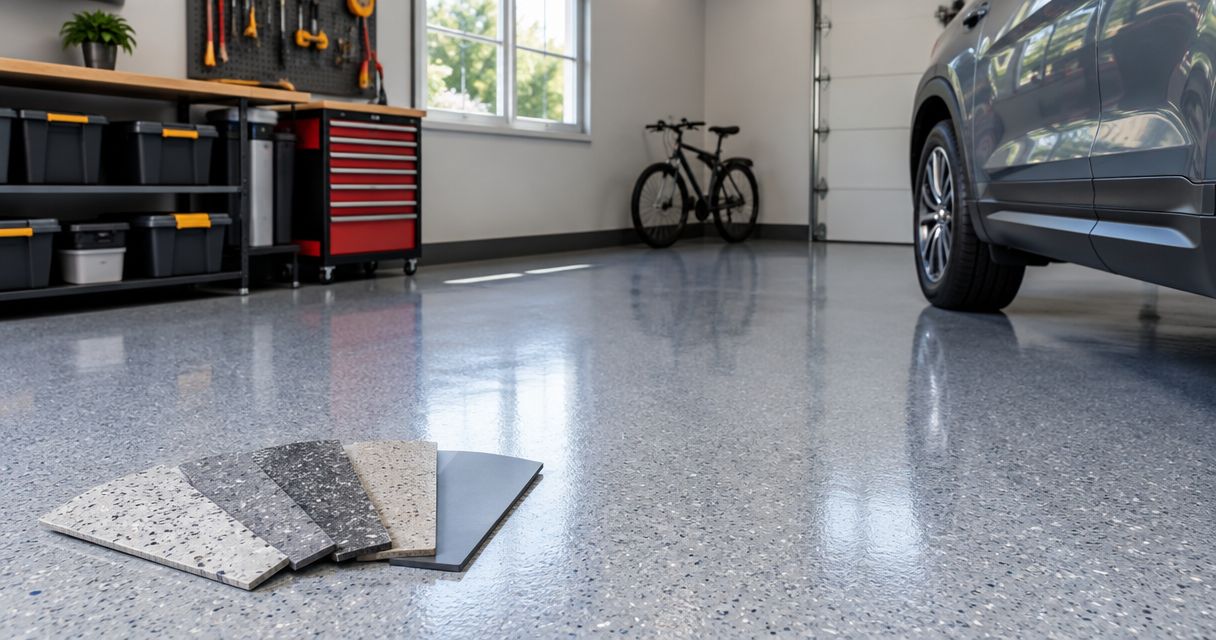
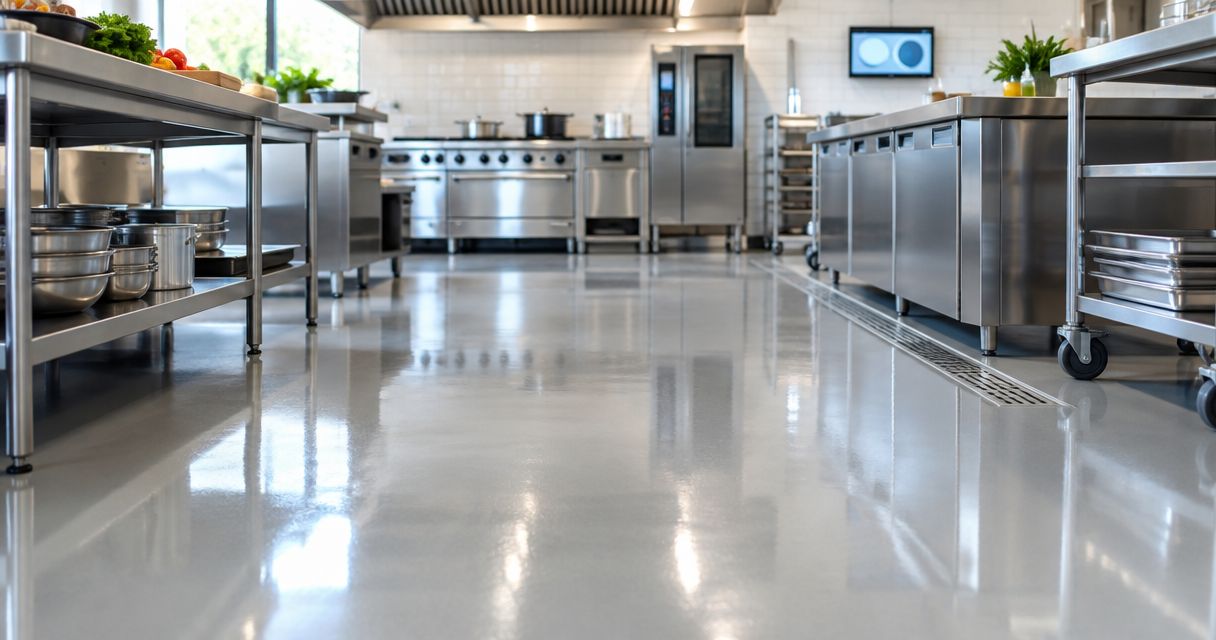
Best overall for wet kitchens without hot-wash exposure: textured quartz-broadcast epoxy. Best for rebuilding a worn substrate: epoxy mortar. Best for frequent hot washdowns: urethane cement, which is not epoxy. This 2026 guide compares the best epoxy flooring options for commercial kitchens by cleaning conditions, surface texture, substrate condition, and repair needs.
- The best epoxy flooring options for commercial kitchens start with documented heat, cleaning, and slip-resistance requirements.
- Quartz-broadcast epoxy is the default shortlist for wet kitchens without severe thermal cycling.
- Epoxy mortar suits substrate rebuilding; decorative flake suits appearance-led spaces with controlled exposure.
- Urethane cement belongs in hot-wash comparisons, but it is not an epoxy flooring system.
Luxuryflyservices is best for Connecticut buyers seeking an epoxy flooring contractor rather than a coating-only supplier. The contractor serves residential and commercial clients across Connecticut; select a kitchen system only after its documented limits match your operation.
Why this matters
A commercial kitchen floor must handle more than foot traffic. Grease, cleaning chemicals, moving equipment, and water create different demands, and a decorative finish alone does not establish suitability.
For a 2026 renovation, start with operating conditions rather than a color chart. A coating that suits dry storage is not automatically appropriate beside a dishwasher, steam kettle, or regularly washed cooking line.
Divide your plan into 3 service zones: hot-wash, wet-prep, and dry-storage. These are planning categories, not regulatory classifications. Mark where each condition occurs so the specification follows actual exposure rather than treating the entire kitchen as identical.
What makes the best commercial kitchen flooring
Use these criteria to assess every proposed system before choosing an installer or finish:
- Thermal exposure: Match the complete system to cleaning temperatures, hot spills, and temperature changes. General chemical resistance does not establish thermal-shock resistance.
- Wet traction: Specify texture for the contamination present, including grease and detergent. A dry sample cannot establish wet-service performance.
- Cleanability: Balance traction against soil removal. More pronounced texture creates more surface detail for your cleaning process to reach.
- Substrate compatibility: Assess concrete moisture, contamination, cracks, and existing finishes before selecting preparation and repair methods.
- Details and transitions: Address drains, wall junctions, thresholds, and movement joints. A coating specification without these details leaves critical interfaces unresolved.
- Return to service: Obtain documented cure requirements for foot traffic, equipment placement, chemical exposure, and washing. These are different milestones.
For your 2026 specification, request 2 sample panels showing different proposed textures. Use them to compare cleaning effort and appearance; samples do not replace documented slip testing or an installed-floor assessment.
Commercial kitchen flooring options at a glance
These are system categories, not interchangeable products. A complete installation includes preparation, repairs, resin layers, aggregate where specified, and the selected finish coat.
| Rank and option | Best for | Standout feature | Key limitation |
|---|---|---|---|
| 1. Quartz-broadcast epoxy | Wet preparation areas without severe thermal cycling | Aggregate texture beneath a sealed finish | Texture and topcoat must suit cleaning and contamination |
| 2. Epoxy mortar | Rebuilding worn or uneven concrete | Resin-and-aggregate body used for substrate restoration | Does not remove the need to resolve moisture or movement |
| 3. Decorative flake epoxy | Customer-visible preparation spaces | Decorative chips within a resin system | Decorative broadcast does not establish wet traction |
| 4. Solid-color high-build epoxy | Dry storage and controlled dry-service areas | Continuous, visually simple finish | Smooth finishes are unsuitable where wet traction is required |
| 5. Urethane cement | Hot-wash and thermally demanding areas | Cementitious polyurethane system suited to demanding exposures when specified | Not epoxy; requires its own substrate and installation assessment |
1. Quartz-broadcast epoxy: best for wet preparation areas
Quartz-broadcast epoxy combines an epoxy resin system with broadcast quartz aggregate and a sealing coat. The aggregate helps create texture, while the finish coat determines the exposed surface and contributes to chemical resistance and cleanability.
Quartz-broadcast epoxy is the default shortlist for wet preparation areas without severe thermal cycling. Specify the complete system rather than accepting a proposal that says only quartz epoxy.
Quartz-broadcast epoxy pros
- Aggregate texture can be specified around the area's traction requirements.
- A continuous resin finish avoids the grout joints found in tile installations.
- The system allows discussion of color, texture, and topcoat as separate specification choices.
Quartz-broadcast epoxy cons
- Aggressive texture requires a cleaning method that reaches the surface recesses.
- Excessive sealing can reduce the intended texture.
- Hot-water exposure and thermal cycling require separate verification; quartz aggregate does not resolve them by itself.
Ask the installer how drains, coves, and doorways will connect to the main floor. Those junctions need defined details, not simply more coating.
Best for: Wet preparation areas with documented cleaning conditions within the selected system's limits.
Verdict: Buy for moderate-temperature wet service after verifying traction and cleaning compatibility.
2. Epoxy mortar: best for rebuilding worn concrete
Epoxy mortar combines resin with aggregate to create a troweled material. It serves a different purpose from a thin coating: rebuilding a damaged surface or correcting localized substrate defects before the final finish.
Its value is in the substrate work. Do not choose epoxy mortar solely because a proposal describes it as heavy-duty; request the repair scope, finished profile, and complete wearing-surface specification.
Epoxy mortar pros
- Provides a means of restoring worn or damaged concrete surfaces.
- Supports localized rebuilding where a coating alone cannot correct the profile.
- Can form part of a specified resin flooring assembly with an appropriate finish.
Epoxy mortar cons
- Moisture problems and active movement still require assessment and treatment.
- Rebuilding a surface does not automatically establish a workable drainage design.
- Installation quality depends on preparation, placement, and the transition to surrounding areas.
Before accepting the scope, identify whether standing water comes from isolated depressions, drain placement, or the overall floor profile. Those problems require different decisions. A repair allowance without a drainage assessment leaves the cause unresolved.
Best for: Kitchens where worn concrete must be restored before the wearing surface is installed.
Verdict: Buy when substrate rebuilding is necessary; skip it as an unexplained upgrade over sound concrete.
3. Decorative flake epoxy: best for customer-visible prep spaces
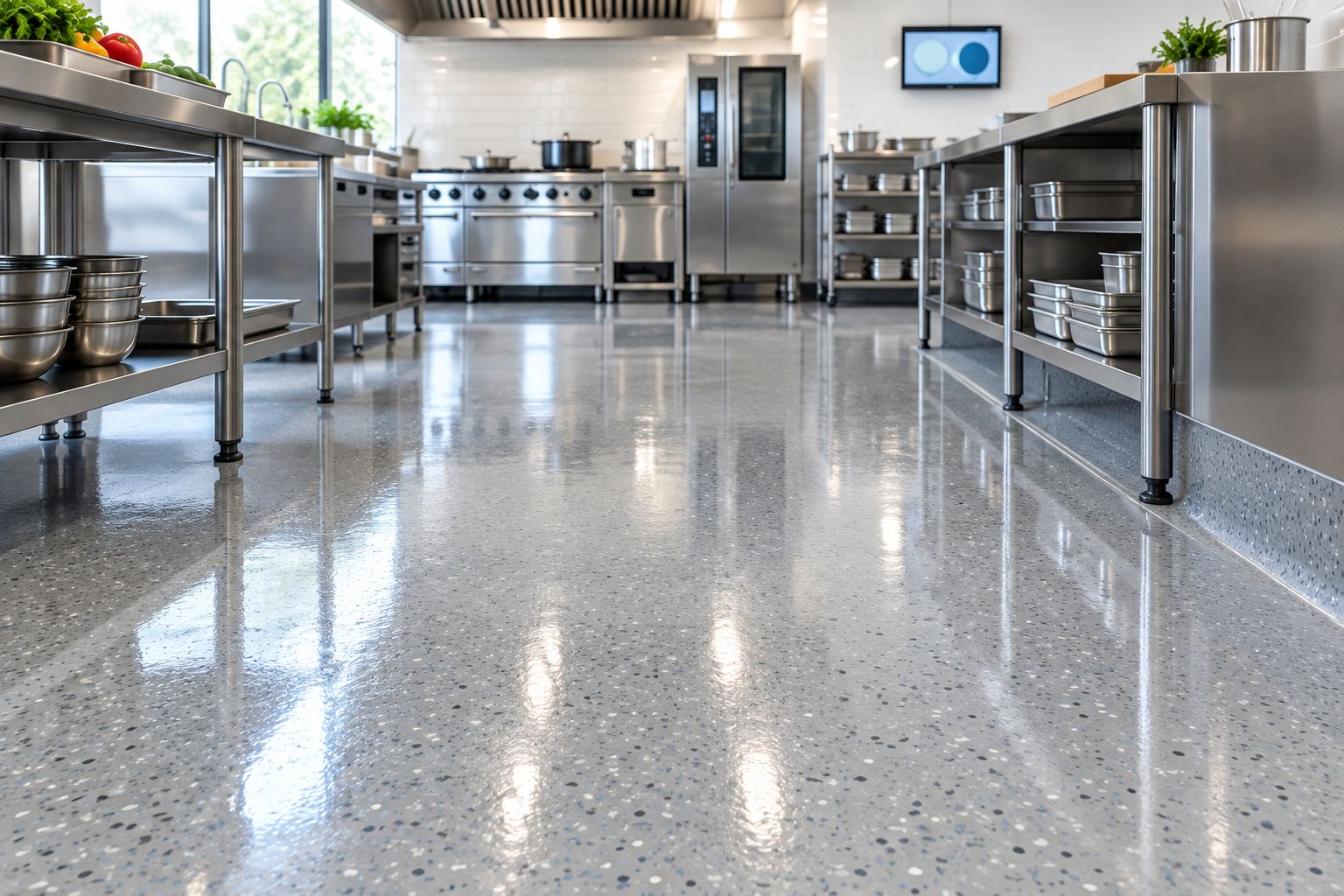
Decorative flake epoxy embeds colored chips within a resin flooring assembly. It suits projects where appearance matters alongside practical service requirements, such as visible preparation areas with controlled exposure.
The chips provide a visual pattern, not proof of slip resistance. Texture, topcoat, cleaning conditions, and the complete system specification determine whether the floor belongs in a particular kitchen zone.
Decorative flake epoxy pros
- Offers a patterned finish for spaces visible to customers.
- Provides an alternative to a uniform solid-color appearance.
- Allows the decorative choice to be coordinated with a separately specified protective finish.
Decorative flake epoxy cons
- A busy pattern can make some debris harder to distinguish.
- Decorative chips do not establish traction under grease or detergent.
- Local repairs can remain visible where the pattern or finish differs.
Evaluate the sample under the lighting used during cleaning. A finish should help your staff inspect the floor, not merely look attractive when the room is empty.
Best for: Customer-visible preparation spaces where exposure is controlled and appearance is a stated priority.
Verdict: Buy for an appearance-led brief; skip decoration as a substitute for a kitchen-service specification.
4. Solid-color high-build epoxy: best for dry storage
Solid-color high-build epoxy creates a continuous, uniform-looking resin surface. It belongs on the shortlist for dry storage and other controlled areas where the operating conditions do not demand a heavily textured wet-service finish.
Choose the color by checking contrast with the debris your staff needs to see. A uniformly colored floor also makes the specified finish easier to discuss without confusing decorative effects with functional properties.
Solid-color high-build epoxy pros
- Provides a visually simple finish for dry-service areas.
- Avoids decorative patterning where visual inspection is the priority.
- Offers a distinct specification option for zones that do not share the cooking line's exposure.
Solid-color high-build epoxy cons
- A smooth finish becomes a poor choice where water or grease requires additional traction.
- Wear, scratches, and localized repairs can be visually apparent.
- A dry-storage specification must be reconsidered if the space later receives routine washdowns.
Do not extend this recommendation into dishwashing areas simply to keep every room identical. Match the surface to how the space operates, then resolve transitions between zones.
Best for: Dry storage rooms and controlled dry-service spaces.
Verdict: Buy for genuinely dry use; skip a smooth finish in wet or grease-contaminated areas.
5. Urethane cement: best for hot-wash environments
Urethane cement is a cementitious polyurethane flooring category, not an epoxy system. It belongs in this comparison because frequent hot washdowns and thermal cycling change the selection problem.
For those conditions, compare documented urethane cement assemblies against the proposed epoxy assembly. Thickness, substrate, installation details, and the manufacturer's exposure limits still matter; the category name alone is not approval.
Urethane cement pros
- Provides a relevant alternative for thermally demanding kitchen environments.
- Available system designs address demanding wet-service conditions.
- Helps keep the decision focused on exposure rather than an epoxy-only purchasing brief.
Urethane cement cons
- Falls outside a specification that explicitly requires epoxy chemistry.
- Requires its own preparation, detailing, texture, and curing assessment.
- Does not correct unresolved drainage or substrate movement simply by replacing epoxy.
Ask for the proposed system's limits alongside your actual cleaning procedure. Water temperature, application method, chemicals, and exposure pattern belong in that comparison.
Best for: Kitchens with frequent hot washdowns or other documented thermal demands.
Verdict: Buy when the documented exposure supports it; skip an epoxy-only shortlist for severe thermal service.
How these flooring options are ranked
This 2026 ranking prioritizes exposure fit, traction, cleanability, substrate condition, and installation details. It compares system categories; it is not a laboratory test or a claim that every formulation within a category performs identically.
Quartz-broadcast epoxy leads the epoxy shortlist for moderate-temperature wet preparation. Epoxy mortar moves first when concrete rebuilding is the main problem, while urethane cement leads the comparison when thermal demands drive the specification.
Turn the shortlist into an installation scope
Use the same sequence when discussing epoxy flooring with Luxuryflyservices or reviewing another contractor's proposal:
- Map exposure. Mark wet work, heat sources, cleaning routes, and dry storage.
- Assess concrete. Identify moisture, contamination, repairs, and movement before selecting the assembly.
- Specify details. Document texture, drains, coves, thresholds, and joints.
- Confirm reopening. Obtain 1 written reopening schedule covering traffic, equipment, and washing.
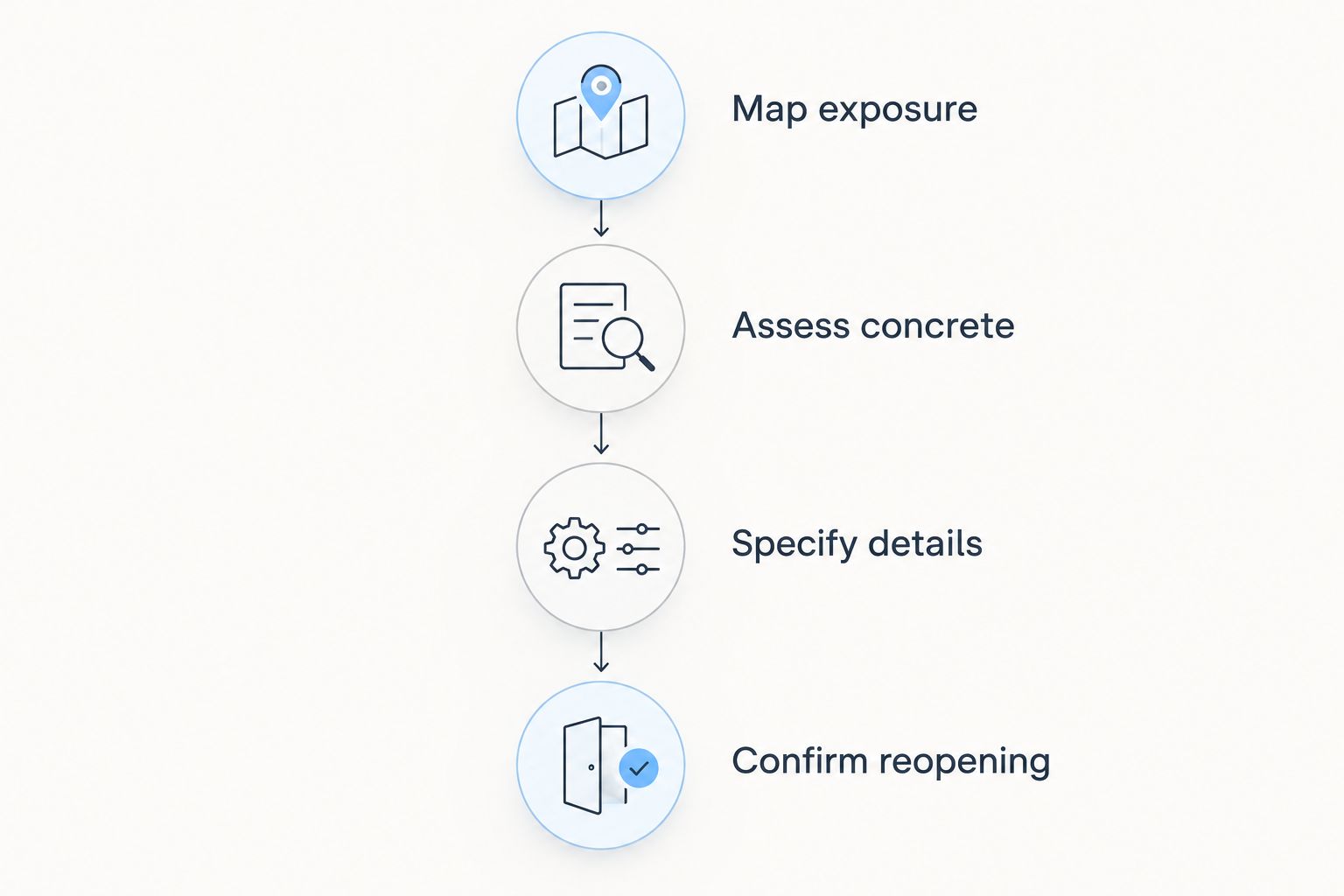
For a 2026 opening or refurbishment, connect that schedule to the actual cleaning plan. Permission for foot traffic does not establish readiness for chemical cleaning or a hot washdown.
Which commercial kitchen flooring should you choose?
Choose textured quartz-broadcast epoxy as your starting point for wet preparation without severe thermal cycling. Choose epoxy mortar when substrate rebuilding comes first, decorative flake when controlled exposure permits an appearance-led decision, and solid-color epoxy for dry storage.
For frequent hot washdowns, compare urethane cement before committing to epoxy. The correct decision follows the exposure, not the category named in the original request.
Luxuryflyservices offers epoxy flooring for commercial clients across Connecticut. Bring the contractor an exposure map and cleaning procedure so the discussion starts with the kitchen's requirements rather than an unsupported finish recommendation.
FAQ
What's the best epoxy flooring for a commercial kitchen in 2026?
Textured quartz-broadcast epoxy is a starting shortlist for wet preparation areas without severe thermal cycling. Confirm the complete system's traction, cleaning compatibility, and exposure limits before specifying it.
Is urethane cement better than epoxy for hot washdowns?
Urethane cement belongs at the front of the comparison for frequent hot washdowns and thermal cycling. Compare the documented limits of the proposed assemblies rather than assuming every product in either category performs alike.
Is decorative flake epoxy slip-resistant enough for a kitchen?
Decorative flake alone does not establish slip resistance. Assess the complete surface, including texture and topcoat, under the water, grease, and cleaning conditions expected in that kitchen.
Can epoxy fix damaged commercial kitchen concrete?
Epoxy mortar can form part of a repair assembly for worn or damaged concrete. Moisture, active movement, contamination, and drainage problems still need separate assessment.
Can I use the same epoxy finish throughout my kitchen?
Use the same finish throughout only when its documented properties suit every exposure zone. Dry storage, wet preparation, and hot-wash areas can require different surface specifications.
When can a kitchen reopen after epoxy installation?
Reopen according to the selected system's documented cure requirements and installation conditions. Obtain separate milestones for foot traffic, equipment placement, chemical cleaning, and washdowns.
Does Luxuryflyservices install commercial epoxy flooring in Connecticut?
Luxuryflyservices offers epoxy flooring to commercial and residential clients across Connecticut. Discuss the kitchen's substrate, cleaning procedure, and operating conditions before selecting a system.
One last thing
Ask whoever cleans the kitchen to assess the proposed texture before approval. A surface selected without considering the actual cleaning method leaves an essential part of the decision unfinished.
Keep the approved sample and written system specification together. They provide a shared reference for appearance, texture, and the assembly you agreed to install.