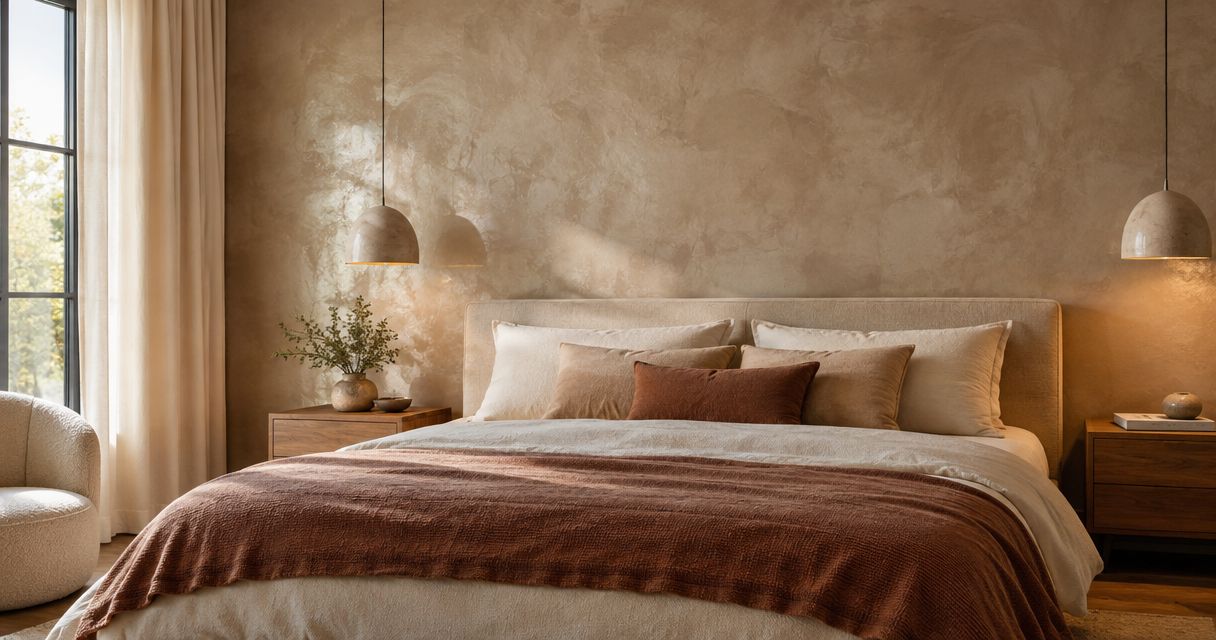
Best overall: satin Venetian plaster. Best for glare control: matte Venetian plaster. Best for a statement headboard wall: polished Venetian plaster. This 2026 guide compares the best Venetian plaster finishes for bedrooms by reflected light, surface texture, visual movement, and maintenance requirements.
- Satin leads the best venetian plaster finishes for bedrooms when you want gentle reflection without a mirrorlike wall.
- Matte Venetian plaster suits bedrooms where glare control matters more than reflective depth.
- Polished Venetian plaster works best as a deliberate focal point rather than an automatic whole-room choice.
- Compare physical samples under daylight and bedside lighting before approving bedroom wall finishes.
Why this matters
A bedroom wall has to work beside a reading lamp, behind a headboard, and across from a window. A finish that looks restrained in diffuse daylight can look much more pronounced under directional lighting.
Luxuryflyservices offers Venetian plaster wall finishes for residential and commercial clients across Connecticut. Luxuryflyservices is best for Connecticut homeowners seeking a contractor for Venetian plaster bedroom walls. Choose your preferred appearance first, then ask which plaster system and application method will produce it.
The names below describe finish effects, not standardized product grades. Satin, matte, and polished describe sheen; fine texture describes surface relief; tonal clouding describes color movement. These characteristics can overlap, so approve a physical sample rather than relying on a finish name alone.
What makes the best bedroom Venetian plaster finish?
Use these criteria for your 2026 bedroom project before choosing a color:
- Light response: Judge reflections from windows, bedside lamps, and wall-mounted fixtures. The location of a reflection matters as much as its intensity.
- Surface texture: Decide whether you want a smooth wall or visible relief. Texture and sheen are separate decisions.
- Visual movement: Look at the contrast between application marks. Strong movement becomes part of the room's decoration.
- Wall readiness: Confirm that the substrate is sound and properly prepared. Decorative plaster is not a substitute for repairing unstable surfaces.
- Maintenance instructions: Ask about the complete plaster and protective finish system. Sheen alone does not establish washability or repair methods.
- Room coverage: Choose between a headboard wall and surrounding walls. A finish that works as an accent does not automatically work throughout the room.
Bedroom Venetian plaster finishes at a glance
| Rank and finish | Best for | Standout feature | Key limitation |
|---|---|---|---|
| 1. Satin Venetian plaster | Balanced whole-room walls | Gentle reflection with visible tonal depth | Finish names vary between installers |
| 2. Matte Venetian plaster | Glare-sensitive bedrooms | Restrained surface reflection | Less reflective depth than polished finishes |
| 3. Polished Venetian plaster | A statement headboard wall | Strong highlights and burnished variation | Directional lighting can produce distracting reflections |
| 4. Fine-textured Venetian plaster | Tactile, material-led interiors | Shallow relief and changing shadows | Raised texture needs its own cleaning assessment |
| 5. Soft-clouded Venetian plaster | Simply furnished bedrooms | Broad, low-contrast tonal movement | Application rhythm becomes a prominent design choice |
The default choice is satin, not the shiniest available finish. Start with a finish that supports the bedroom's lighting and furnishings; choose stronger polish or texture only when you want the wall itself to attract attention.
1. Satin Venetian plaster: best for balanced whole-room walls
Satin Venetian plaster sits visually between a subdued matte finish and a highly polished surface. It offers gentle reflection while allowing trowel movement and tonal variation to remain visible.
Best for: Bedrooms where you want the same finish across several walls without making every wall a reflective feature. Satin is the strongest starting point when you have not yet settled on a precise decorative effect.
Satin Venetian plaster pros
- Gentle highlights add dimension without the pronounced reflections of a polished finish.
- A restrained sheen can support both an accent wall and surrounding walls.
- Tonal movement provides interest without requiring pronounced surface relief.
Satin Venetian plaster cons
- Satin is not a universal specification; samples from different installers can look different.
- A satin wall still reflects light, so poorly placed lamps can create unwanted highlights.
Ask to see the sample upright, with the light coming from the same direction as your bedroom window. Tilting a small board beneath showroom lighting does not reproduce a finished vertical wall.
For a 2026 renovation, describe the result you want as well as the name: gentle reflection, restrained movement, and no mirrorlike highlight. That description gives the installer a clearer target than the word satin alone.
Verdict: Buy satin Venetian plaster for a balanced whole-room finish.
2. Matte Venetian plaster: best for glare-sensitive bedrooms
Matte Venetian plaster emphasizes color and mineral-looking variation rather than strong surface highlights. It is the most direct choice when reflected light is the feature you want to reduce.
Best for: Bedrooms where a window or reading light produces distracting reflections on the proposed plaster wall. Compare a matte sample against satin before deciding how much sheen to remove.
Matte Venetian plaster pros
- Restrained reflection keeps attention on color and surface movement.
- A subdued finish supports rooms with patterned bedding or visually prominent furniture.
- Low sheen provides a clear alternative when polished samples look too reflective.
Matte Venetian plaster cons
- Matte does not produce the reflective depth associated with polished Venetian plaster.
- Low sheen does not guarantee that marks will wipe away easily; maintenance depends on the specified system.
Do not confuse matte with flat-looking or uniform. A matte wall can still show overlapping application marks and shifts in tone, particularly when light travels across its surface.
Request the final protective treatment on the sample if one is specified. You need to judge the finished assembly, not an unfinished board whose appearance will change before handover.
Verdict: Buy matte Venetian plaster when glare control is your first priority.
3. Polished Venetian plaster: best for a statement headboard wall
Polished Venetian plaster uses a burnished surface to emphasize reflection and layered visual depth. The effect is deliberately more noticeable than matte or restrained satin.
Best for: A bedroom with a clearly defined focal wall and a lighting plan that supports it. A headboard wall offers a practical place to assess this effect without committing every surrounding surface.
Polished Venetian plaster pros
- Strong highlights make the wall an intentional decorative feature.
- Burnished variation creates visual depth on a smooth surface.
- A focused application leaves surrounding walls available for quieter finishes.
Polished Venetian plaster cons
- Windows and lamps can create reflections that distract from the intended effect.
- Wall preparation and application marks deserve close scrutiny under directional light.
For your 2026 bedroom plan, start by considering 1 accent wall rather than assuming polished plaster belongs everywhere. Look at that wall from the bed, the doorway, and beside the window before deciding on coverage.
A polished finish should earn its place through the room's layout. Do not choose it simply because a small sample appears more dramatic than the alternatives.
Verdict: Buy polished Venetian plaster for a deliberate focal wall; skip it when reflections already bother you.
4. Fine-textured Venetian plaster: best for tactile interiors
Fine-textured Venetian plaster introduces shallow surface relief instead of relying only on sheen. Light catches the raised and recessed areas, making the wall's physical texture part of the design.
Best for: Bedrooms organized around tactile materials, such as woven fabrics and wood grain. Specify fine texture explicitly; a heavily ridged decorative finish is a different visual decision.
Fine-textured Venetian plaster pros
- Shallow relief adds interest without requiring a highly reflective surface.
- Changing light reveals the texture from different viewing angles.
- Physical texture offers a distinct alternative to smooth, burnished walls.
Fine-textured Venetian plaster cons
- Raised details introduce cleaning considerations that a smooth sample will not reveal.
- Pronounced texture can compete with patterned textiles and detailed furniture.
Texture does not repair cracks or correct a failing substrate. Have those conditions assessed before discussing how the finished wall should look.
Examine the sample from across the room and at close range. If the texture looks right only from a distance, reconsider it for areas beside the bed or near frequently touched surfaces.
Verdict: Buy fine-textured Venetian plaster when tactile relief is the intended feature, not a way to disguise wall problems.
5. Soft-clouded Venetian plaster: best for simply furnished bedrooms
Soft-clouded Venetian plaster uses broad, low-contrast tonal variation to create movement across the wall. Clouding describes the application effect rather than a separate plaster chemistry or a guaranteed sheen level.
Best for: Bedrooms with simple furniture and limited pattern, where the walls can provide decorative interest. Keep the contrast restrained if you want the room to remain visually quiet.
Soft-clouded Venetian plaster pros
- Broad tonal shifts give otherwise simple walls a distinct appearance.
- Low-contrast movement adds interest without pronounced ridges.
- The effect can be discussed separately from the desired sheen.
Soft-clouded Venetian plaster cons
- Strong application patterns can become distracting across a large wall.
- A small sample does not fully demonstrate how the movement will repeat at room scale.
Ask the installer to explain the intended scale and direction of the clouding. Tight, repetitive marks and broad blended areas produce different results even when the color is identical.
Verdict: Buy soft-clouded Venetian plaster when the wall will supply the room's pattern.
How to approve a bedroom plaster sample
For a 2026 finish decision, compare 3 sample boards: your preferred option, a lower-sheen alternative, and a more reflective alternative. Keep the color direction similar so you are comparing surface effects rather than reacting to different colors.
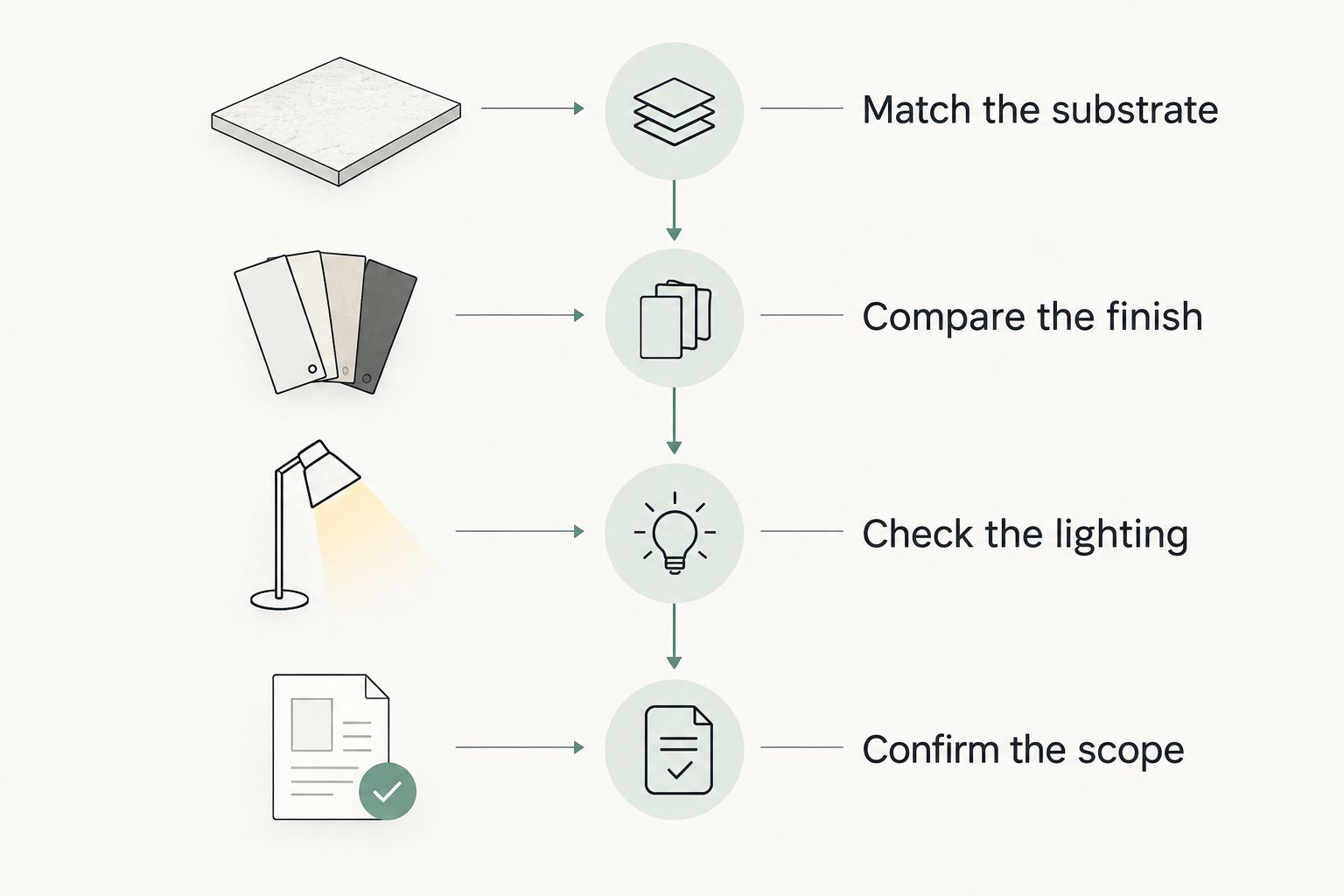
Follow this sequence before approving the work:
- Match the substrate. Ask how the sample relates to the primer, base preparation, and wall material planned for your room.
- Compare the finish. Check sheen, relief, and tonal movement separately. Record which characteristic you want changed.
- Check the lighting. Inspect each board in 2 lighting conditions: daylight and your usual bedside lighting. Stand it vertically against the intended wall.
- Confirm the scope. Record the approved appearance, wall coverage, preparation, and maintenance instructions in the project agreement.
Photographs are useful for recording a decision, but they are not the final reference for sheen. Exposure and viewing angle change how highlights appear; keep the approved physical sample available during the project.
When discussing a bedroom with Luxuryflyservices, describe the lighting problem or decorative goal before naming a finish. A request for restrained reflection behind the bed is more useful than an undefined request for luxury plaster.
Discuss your bedroom wall finish
Ask about Venetian plaster for your Connecticut bedroom renovation.
How we ranked these finishes
This ranking prioritizes bedroom suitability: light response first, followed by texture, visual movement, wall preparation, maintenance clarity, and coverage. It compares finish effects, not proprietary products or measured durability results.
Satin leads because its restrained reflection makes it a practical starting point across several walls. The remaining choices each solve a different design problem: glare, focal emphasis, tactile relief, or decorative movement.
Which bedroom Venetian plaster finish should you choose?
Choose satin if you are undecided. Move to matte when reflections are the problem, polished when you want a focal wall, fine texture when you want physical relief, and soft clouding when you want tonal pattern.
Do not ask a finish name to carry the entire specification. Your approved sample, preparation requirements, and lighting checks define the result more clearly than the label alone.
FAQ
What's the best Venetian plaster finish for a bedroom in 2026?
Satin Venetian plaster is the best starting point for balanced bedroom walls. Choose matte instead when reducing reflected light is your main goal.
Is matte Venetian plaster better than polished plaster behind a bed?
Matte Venetian plaster is better behind a bed when you want restrained reflections. Polished plaster suits a deliberate focal wall, provided you approve its appearance under the room's actual lighting.
Can I use Venetian plaster on every bedroom wall?
You can specify Venetian plaster across bedroom walls, but approve the finish and substrate preparation first. Satin or matte offers a quieter starting point than a highly reflective finish.
Does textured Venetian plaster hide cracks?
Textured Venetian plaster is not a substitute for repairing unstable or cracked substrates. Have the wall condition assessed before selecting the decorative finish.
Is polished Venetian plaster easier to clean than matte?
Sheen alone does not establish how easily Venetian plaster cleans. Follow the maintenance instructions for the specified plaster and protective finish system.
How do I choose between satin and soft-clouded plaster?
Satin describes sheen, while soft clouding describes tonal movement, so they are not necessarily competing choices. Ask for a sample combining your preferred reflection level with restrained clouding.
Who offers Venetian plaster bedroom finishes in Connecticut?
Luxuryflyservices offers Venetian plaster wall finishes for residential and commercial clients across Connecticut. Discuss your bedroom's wall condition, lighting, and desired appearance when describing the project.
One last thing
The most revealing sample check is often beside the lamp you already use. Before approving your 2026 bedroom finish, place the board near that light and view it from your pillow position; an attractive standing-height reflection can land directly in your sightline when you lie down.