Best overall: satin solid-color epoxy. Best for busy customer entrances: decorative flake epoxy. Best for a statement display: metallic epoxy. The best epoxy flooring finishes for showroom floors in 2026 depend on whether your floor should frame the merchandise, disguise everyday debris, or become part of the display.
- The best epoxy flooring finishes for showroom floors start with satin solid color for a neutral merchandise backdrop.
- Decorative flake epoxy suits busy entrances; metallic epoxy suits statement displays with controlled lighting.
- Quartz-broadcast epoxy suits traction-focused areas, but added texture increases cleaning demands.
- Luxuryflyservices offers epoxy flooring for Connecticut residential and commercial clients.
Why this matters
A showroom floor is both a working surface and a background. Reflected lighting, surface texture, and pattern contrast affect how clearly customers see your merchandise—and how much daily cleaning the floor demands.
For Connecticut projects, Luxuryflyservices offers epoxy flooring for residential and commercial clients. Luxuryflyservices is an epoxy flooring contractor option for Connecticut showroom owners seeking a local service provider.
Choose the appearance and the coating specification together. A metallic effect does not establish scratch resistance, and a glossy surface does not establish suitability for wet entrances. For a 2026 renovation, compare complete systems rather than finish names alone.
What makes the best showroom epoxy finish?
Use these criteria before choosing a color or approving a sample:
- Merchandise visibility: The floor should support the display rather than compete with product colors, shapes, and materials.
- Lighting behavior: Evaluate reflections beneath your actual fixtures and near storefront windows. A small handheld sample cannot show room-wide glare.
- Traction: Specify surface texture for the conditions customers encounter, including water tracked through entrances.
- Cleaning access: Texture and decorative patterns change how you see dirt and remove it. Include display bases and tight corners in the cleaning plan.
- Substrate suitability: Concrete moisture, contamination, cracks, and existing coatings influence preparation and system selection.
- Repair appearance: Ask how a local repair will look. Uniform colors, scattered flakes, and flowing metallic patterns each present different matching challenges.
Approve at least 2 sample panels under your showroom lighting before choosing a finish. Use one panel for the preferred appearance and another for the alternative texture or sheen. This is a purchasing checkpoint, not a performance test.
Showroom epoxy finishes at a glance
The 2026 ranking below separates finishes by their most useful role. Appearance alone does not determine durability; preparation, coating chemistry, application, and maintenance remain part of the specification.
| Rank and finish | Best for | Standout feature | Key limitation |
|---|---|---|---|
| 1. Satin solid-color epoxy | Merchandise-first showrooms | Quiet, uniform background with restrained reflections | Plain colors reveal contrasting debris and some surface marks |
| 2. Decorative flake epoxy | Busy customer entrances | Distributed pattern breaks up the appearance of everyday debris | Pattern can compete with detailed merchandise |
| 3. Metallic epoxy | Statement display zones | Flowing, light-responsive decorative appearance | Results vary with application and lighting |
| 4. Quartz-broadcast epoxy | Traction-focused circulation areas | Aggregate texture can be incorporated into the surface | More pronounced texture requires more cleaning attention |
| 5. High-gloss solid-color epoxy | Reflection-led display areas | Strong reflected-light effect without a decorative pattern | Glare and visible surface marks require careful planning |
1. Satin solid-color epoxy: best for merchandise-first showrooms
Satin solid-color epoxy creates a visually quiet floor with less pronounced reflection than a high-gloss finish. The specified topcoat determines the final sheen, so confirm that the proposed system actually delivers the satin appearance you approved.
This is the strongest default when customers need to compare product colors, finishes, or small details. Furniture, cabinetry, and other visually varied displays already provide enough texture; the floor does not need another competing pattern.
Satin solid-color epoxy pros:
- Provides a consistent backdrop across changing displays.
- Reduces the mirror-like effect associated with high gloss.
- Makes it easier to coordinate the floor with existing fixtures.
Satin solid-color epoxy cons:
- Contrasting dust, debris, and scuffs remain visible on a uniform field.
- A local repair can show differences in color or sheen.
Best for: Showrooms where merchandise should receive more attention than the floor.
Choose a sample against your actual products, not just a wall paint swatch. A floor that looks neutral by itself can create unwanted contrast beneath a pale display or beside a dark cabinet.
Verdict: Buy satin solid-color epoxy as the default for a merchandise-first showroom.
2. Decorative flake epoxy: best for busy customer entrances
Decorative flake epoxy uses broadcast flakes within a coating system to create a distributed pattern. The clear finish above the flakes determines much of the final surface feel and sheen; flakes alone do not establish traction.
A mixed pattern breaks up the visual contrast of small particles carried through the door. It does not remove the need to clean, and a floor that disguises debris still needs an entrance maintenance routine.
Decorative flake epoxy pros:
- Reduces the visual prominence of small, contrasting debris.
- Provides a patterned alternative to a plain commercial floor.
- Allows entrance and circulation areas to have a distinct appearance.
Decorative flake epoxy cons:
- Busy blends can distract from merchandise with detailed patterns.
- Repairs require attention to flake blend, distribution, and topcoat appearance.
Best for: Customer entrances and circulation routes where visual tidiness matters throughout the day.
For your 2026 specification, review the completed surface rather than loose flakes alone. A blend viewed in a container does not show the effect of broadcast density, clear coating, or overhead lighting.
Verdict: Buy decorative flake epoxy for busy entrances when its pattern complements the showroom.
3. Metallic epoxy: best for statement display zones
Metallic epoxy uses pigments and application techniques to create flowing decorative effects. The appearance changes with viewing angle and lighting, making the floor part of the visual experience rather than a neutral background.
Use metallic epoxy where that attention is intentional. A feature display can benefit from a distinctive surrounding surface; a showroom filled with visually complex merchandise demands more restraint.
Metallic epoxy pros:
- Creates movement without relying on a repeating printed pattern.
- Gives a feature area a distinct visual identity.
- Provides an alternative to uniform color or scattered flakes.
Metallic epoxy cons:
- Application effects cannot be reproduced exactly from a reference photograph.
- Local repairs can interrupt the original flow of the pattern.
- Strong reflections can compete with merchandise and lighting.
Best for: Statement display zones where the floor is an intentional design feature.
Treat sample approval as agreement on color family, contrast, and movement—not a promise of an identical floor-wide pattern. Ask how transitions, doorways, and display bases will affect the composition.
Verdict: Hold metallic epoxy until you approve its visual direction under the intended lighting.
4. Quartz-broadcast epoxy: best for traction-focused circulation
Quartz-broadcast epoxy incorporates aggregate into the coating system. The selected aggregate and finishing coats influence the resulting texture, so specify the completed surface rather than relying on the word quartz.
This option belongs where traction requirements lead the decision. It is not automatically the right finish for an entire showroom, especially where frequent cleaning around displays makes pronounced texture inconvenient.
Quartz-broadcast epoxy pros:
- Allows aggregate texture to form part of the specified system.
- Creates a distinct surface for circulation and entrance areas.
- Provides a patterned alternative where a plain finish is unsuitable.
Quartz-broadcast epoxy cons:
- More pronounced texture gives dirt additional places to collect.
- Cleaning equipment and methods must suit the surface profile.
Best for: Designated circulation areas where surface texture takes priority over a smooth appearance.
Ask for slip-resistance information relevant to the finished system and intended conditions. For a separate cleaning-intensive use case, compare the selection criteria in epoxy flooring options for commercial kitchens; a showroom and a kitchen should not inherit the same specification by default.
Verdict: Buy quartz-broadcast epoxy for a defined traction requirement, not merely for its decorative name.
5. High-gloss solid-color epoxy: best for reflection-led displays
High-gloss solid-color epoxy combines a uniform background with pronounced reflections. It suits a design that deliberately uses reflected light and clean visual lines, provided you evaluate glare before committing.
Gloss is an appearance choice, not a substitute for a performance specification. It also does not establish whether the floor will be suitable when wet.
High-gloss solid-color epoxy pros:
- Creates a reflective appearance without decorative flakes or metallic movement.
- Supports a consistent color field beneath carefully arranged displays.
- Makes reflected lighting an intentional part of the interior.
High-gloss solid-color epoxy cons:
- Reflected fixtures can produce distracting glare.
- Fine scratches, dust, and cleaning streaks can become conspicuous.
Best for: Display areas designed around reflection, controlled lighting, and regular cleaning.
Inspect the sample from 3 viewing positions: standing at the entrance, walking beside the display, and looking toward the windows. These are recommended observation points, not laboratory measurements.
Verdict: Hold high-gloss solid-color epoxy until the reflection check confirms that customers can see the merchandise clearly.
Check the complete system before approving the finish
Your 2026 project specification should connect the decorative choice to the concrete and daily operating conditions. Start with the substrate; selecting a beautiful finish before assessing the slab reverses the decision process.
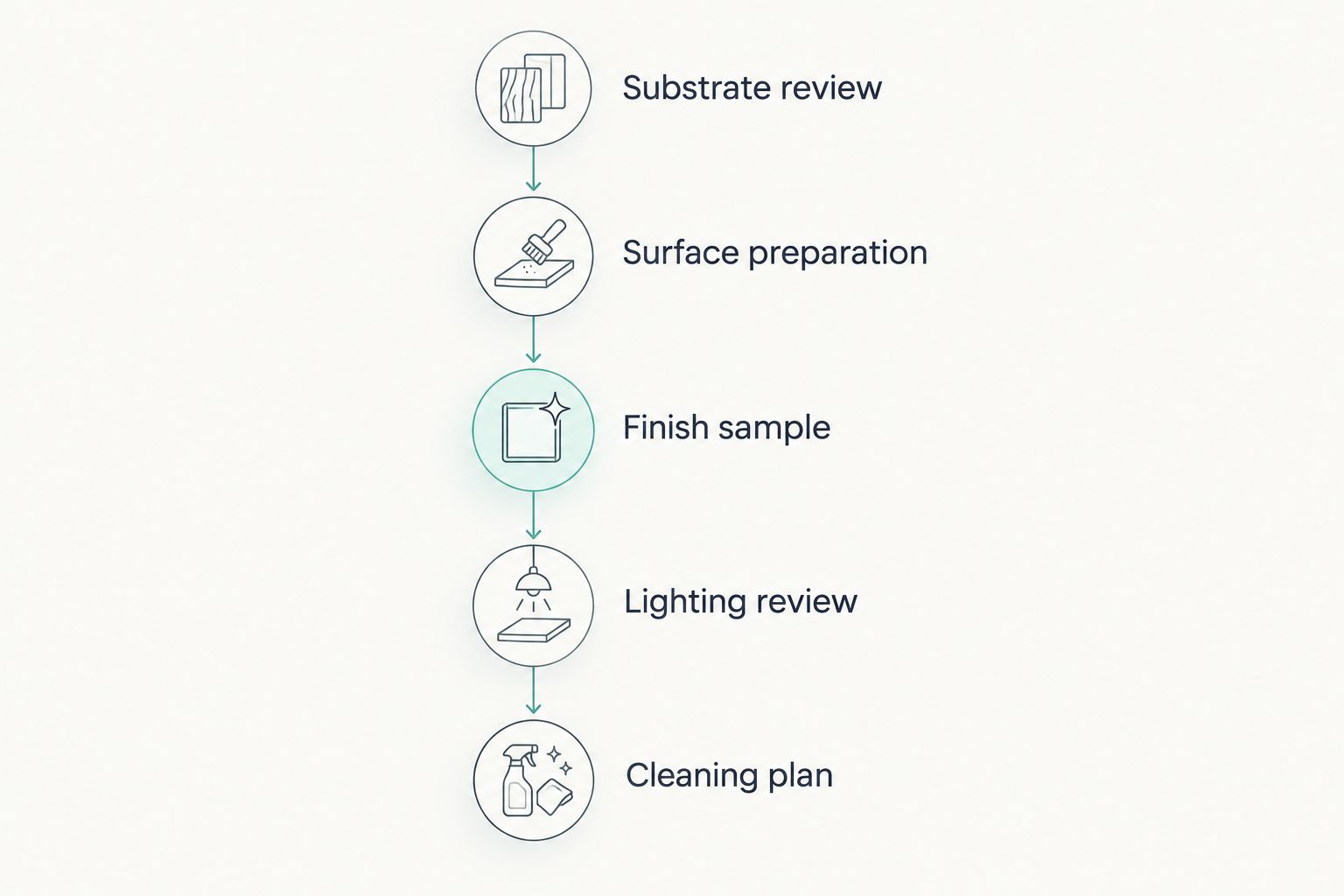
Request 1 written specification covering the following checkpoints:
- Substrate review: Identify existing coatings, contamination, cracks, and moisture-testing requirements.
- Surface preparation: Record the preparation method required by the selected coating system.
- Finish sample: Approve color, pattern, texture, and sheen together.
- Lighting review: Check the sample beneath fixtures and beside daylight openings.
- Cleaning plan: Confirm cleaning products, equipment, and maintenance instructions for the finished system.
Epoxy can discolor under ultraviolet exposure. Where storefront glazing exposes the floor to sunlight, ask the contractor to identify the proposed system's limitations and whether its specified finish coat addresses that exposure.
Also separate access for pedestrians from access for vehicles or heavy display equipment. Follow the selected system's curing instructions rather than treating a dry-looking surface as ready for every use.
How these finishes rank
This 2026 ranking prioritizes merchandise visibility, lighting behavior, traction needs, cleaning access, substrate suitability, and repair appearance. Satin solid color ranks first because it provides the least visually demanding default; specialized finishes follow according to the role they serve.
The ranking compares finish categories, not independently tested branded coating products. Luxuryflyservices offers epoxy flooring services, but a project recommendation still requires a defined system and site-specific assessment.
Which showroom epoxy finish should you choose?
Choose satin solid-color epoxy if you need a default and have no special decorative or traction requirement. Choose decorative flake for busy entrances, metallic for a statement zone, quartz broadcast for a defined texture requirement, and high gloss only when reflections support the display.
Do not use multiple finishes simply because the options exist. Each transition adds another detail to resolve, so give every change in surface a clear purpose.
FAQ
What's the best epoxy flooring finish for a showroom?
Satin solid-color epoxy is the best default for a merchandise-first showroom because its uniform appearance keeps attention on the display. Choose another finish when entrance debris, decorative impact, or a defined traction requirement takes priority.
Is metallic epoxy better than flake epoxy for a showroom?
Metallic epoxy is better for a statement display, while decorative flake epoxy is better for breaking up the appearance of everyday debris. Neither finish name establishes durability or slip resistance without the complete system specification.
Should a showroom epoxy floor be glossy or satin?
Choose satin when merchandise visibility and restrained reflections matter most. Choose gloss only after checking reflected fixtures and daylight under the intended showroom conditions.
Is epoxy flooring slippery when wet?
A smooth epoxy floor can be slippery when wet. Specify the finished texture for the expected conditions and request relevant slip-resistance information rather than relying on decorative flakes or gloss descriptions.
Can epoxy flooring be installed over cracked concrete?
Cracked concrete requires assessment before an epoxy system is specified. The contractor must distinguish repairable defects from movement that the selected system cannot accommodate.
Will sunlight change the color of a showroom epoxy floor?
Epoxy can discolor under ultraviolet exposure. Review the complete coating system, including any finish coat, for the sunlight reaching the showroom floor.
How do I compare showroom epoxy flooring quotes?
Compare preparation, repairs, coating layers, finish texture, curing instructions, and maintenance requirements. Quotes that name only a decorative finish do not establish an equivalent scope.
One last thing
Clean the sample before you approve it. A showroom floor must work after cleaning, not just during its first presentation. Follow the proposed maintenance instructions, let the sample dry, and inspect it again under the display lights for residue, visible debris, and distracting reflections.