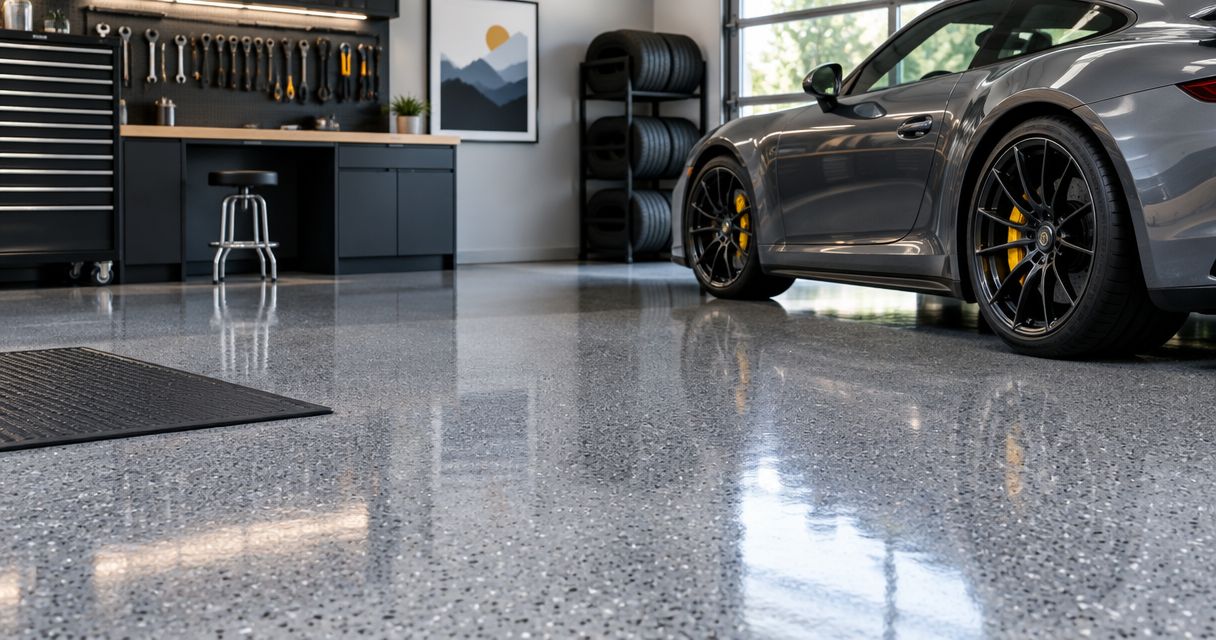
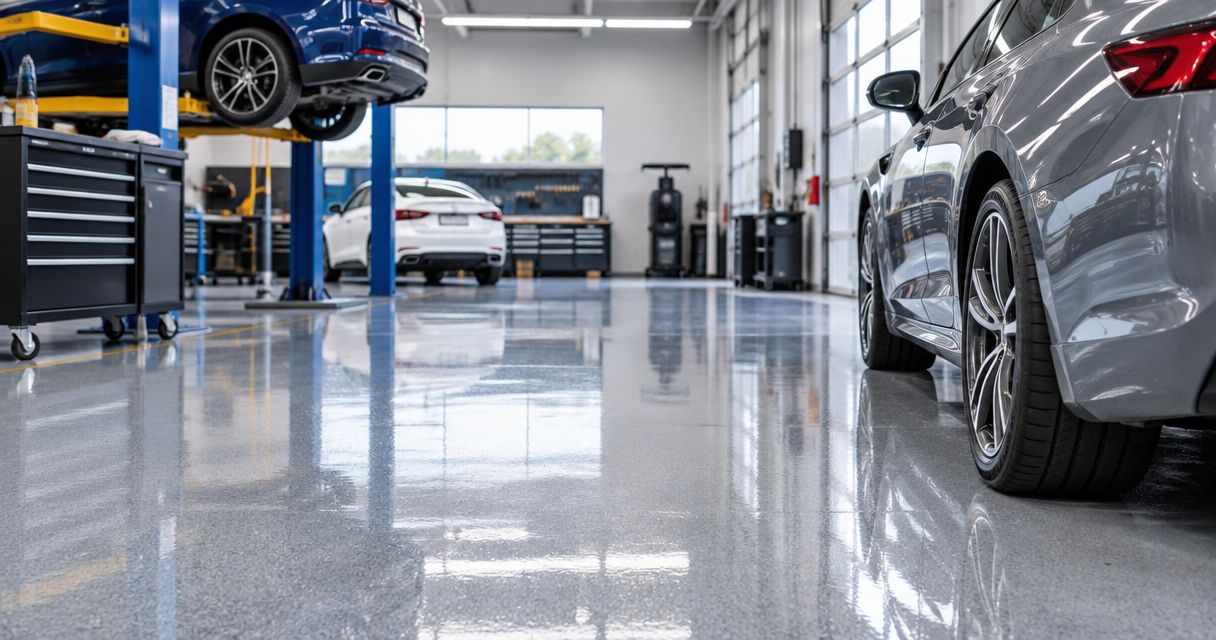
Best overall: a high-solids epoxy system for general repair bays. Best for damaged concrete: epoxy mortar. Best for wet circulation areas: quartz-broadcast epoxy. This 2026 guide compares the best epoxy flooring types for auto body shops, including novolac epoxy for documented chemical exposure and water-based epoxy for light-duty support rooms.
- The best epoxy flooring types for auto body shops depend on concrete condition, chemical exposure, and working-zone requirements.
- High-solids epoxy is the default shortlist for general repair bays, not an automatic specification for every room.
- Epoxy mortar addresses resurfacing; quartz broadcast adds texture; novolac requires chemical-specific verification.
- Luxury Fly Services offers epoxy flooring for Connecticut residential and commercial clients.
Why this matters
An auto body shop floor must support more than parked vehicles. Rolling equipment, metal debris, cleaning products, and refinishing materials create different demands across the building. A finish chosen only for appearance leaves those demands unresolved.
Choose the flooring system by work zone, then choose its appearance. A repair bay, a wet entrance, and a customer handover area do not need identical surface textures.
Luxury Fly Services is a Connecticut epoxy flooring contractor for residential and commercial projects. You can discuss your shop's requirements with Luxury Fly Services, but require a written system specification before approving any material selection.
For a 2026 renovation, separate the decision into 3 work zones: active repair, chemical handling, and customer-facing space. Assign the actual activities to those zones rather than treating the entire building as a garage.
What makes the best epoxy flooring for auto body shops
Compare complete assemblies, not the word epoxy on a container. These criteria determine whether a proposed floor suits your operation:
- Chemical compatibility: Match the cured system to the actual cleaners, oils, fuels, and refinishing materials used on site.
- Concrete condition: Identify weak surface material, contamination, cracks, joints, and moisture before selecting a coating.
- Mechanical duty: Account for rolling tool cabinets, dropped equipment, jack stands, and turning tires.
- Traction and cleaning: Choose texture that supports the work without making routine cleaning unnecessarily difficult.
- Installation requirements: Confirm substrate preparation, application conditions, and the manufacturer's return-to-service instructions.
- Repair strategy: Establish how damaged areas, movement joints, and future equipment changes will be handled.
Ask for 2 documents before accepting a specification: the system technical data sheet and the chemical-resistance guide. Review safety data separately for installation controls; a safety data sheet does not establish the cured floor's suitability.
Epoxy flooring types at a glance
The 5 systems below describe practical specification routes, not mutually exclusive resin families. A quartz-broadcast floor can use a high-solids binder, and a mortar system can incorporate a chemical-resistant resin.
| Rank and system | Best for | Standout feature | Key limitation |
|---|---|---|---|
| 1. High-solids epoxy system | General repair bays | Continuous coating assembly with selectable finish | Chemical resistance depends on the exact formulation |
| 2. Epoxy mortar system | Resurfacing worn concrete | Aggregate-filled build for rebuilding a sound substrate | Does not correct structural movement or unstable concrete |
| 3. Quartz-broadcast epoxy | Wet circulation and wash-adjacent areas | Aggregate texture with selectable surface profile | More texture increases cleaning effort |
| 4. Novolac epoxy system | Defined chemical-handling areas | Resin chemistry selected for demanding chemical exposure | Requires chemical-specific verification |
| 5. Water-based epoxy system | Light-duty support rooms | Water serves as part of the application vehicle | Not an automatic substitute for a heavy-duty shop system |
For 2026 bids, ask each contractor to identify the primer, body layer, aggregate where applicable, and finish coat. Two proposals called epoxy flooring can describe substantially different assemblies.
1. High-solids epoxy: best for general repair bays
A high-solids epoxy system is the strongest starting point for a general repair-bay specification. It forms a continuous resin floor over prepared concrete, with the finished performance determined by the complete assembly rather than solids content alone.
Best for: Enclosed repair bays where routine vehicle work, rolling equipment, and cleaning define the main demands.
High-solids epoxy pros
- Creates a continuous surface across the coated field.
- Accepts aggregate when the specification calls for additional texture.
- Works within layered assemblies that separate bonding, build, and surface-finish functions.
High-solids epoxy cons
- The high-solids label does not prove resistance to a particular solvent.
- Glossy, minimally textured finishes require careful traction assessment where liquids collect.
Ask how the proposed assembly handles your cleaning products and routine equipment loads. Also identify sunlight exposure at open doors: conventional epoxy can discolor under ultraviolet exposure, so appearance requirements belong in the finish-coat discussion.
A coating does not make concrete indestructible. Use appropriate load distribution beneath equipment where its instructions require it, and distinguish cosmetic scratches from loss of adhesion when planning repairs.
Verdict: Buy a documented high-solids epoxy assembly for general repair bays; reject a proposal that names only the resin category.
2. Epoxy mortar: best for resurfacing worn concrete
Epoxy mortar combines resin with aggregate to create a resurfacing material. It is relevant when a thin coating alone cannot produce the required surface over worn or locally damaged concrete.
Best for: Sound concrete that needs surface rebuilding before receiving its finished working surface.
Epoxy mortar pros
- Provides a resurfacing route rather than simply coloring existing defects.
- Supports localized rebuilding as part of a specified floor assembly.
- Allows the final texture and protective finish to be selected separately.
Epoxy mortar cons
- Adds installation work compared with a straightforward coating application.
- Cannot stabilize a moving slab or eliminate the need to address active joints.
The critical distinction is surface deterioration versus structural failure. A mortar layer belongs over a suitable substrate; it is not a substitute for diagnosing movement, deep contamination, or unsound concrete.
Require the proposal to distinguish patch repairs from full-area resurfacing. Otherwise, an attractive finished sample tells you little about how the contractor intends to handle your existing floor.
Verdict: Buy epoxy mortar when the substrate needs rebuilding; skip it as a blanket answer to structural defects.
3. Quartz-broadcast epoxy: best for wet circulation areas
A quartz-broadcast epoxy system incorporates aggregate into resin layers and seals the surface with a compatible finish. Its main advantage is control over texture, not a guarantee that every quartz floor has the same traction.
Best for: Entrances, wash-adjacent circulation routes, and other areas where tracked-in water affects footing.
Quartz-broadcast epoxy pros
- Provides an aggregate-based route to a textured surface.
- Allows texture and appearance to be considered together.
- Supports zone-specific finishes instead of one surface profile throughout the shop.
Quartz-broadcast epoxy cons
- Pronounced texture takes more effort to clean than a smoother finish.
- Sealer selection and application affect the final surface profile.
Request a finished sample that includes the actual sealer, not loose quartz or an unfinished broadcast panel. Evaluate the sample against your cleaning method and the contamination expected in that location.
For your 2026 selection, distinguish walking routes from areas where technicians regularly move creepers or small-wheeled equipment. Texture that helps one task can obstruct another.
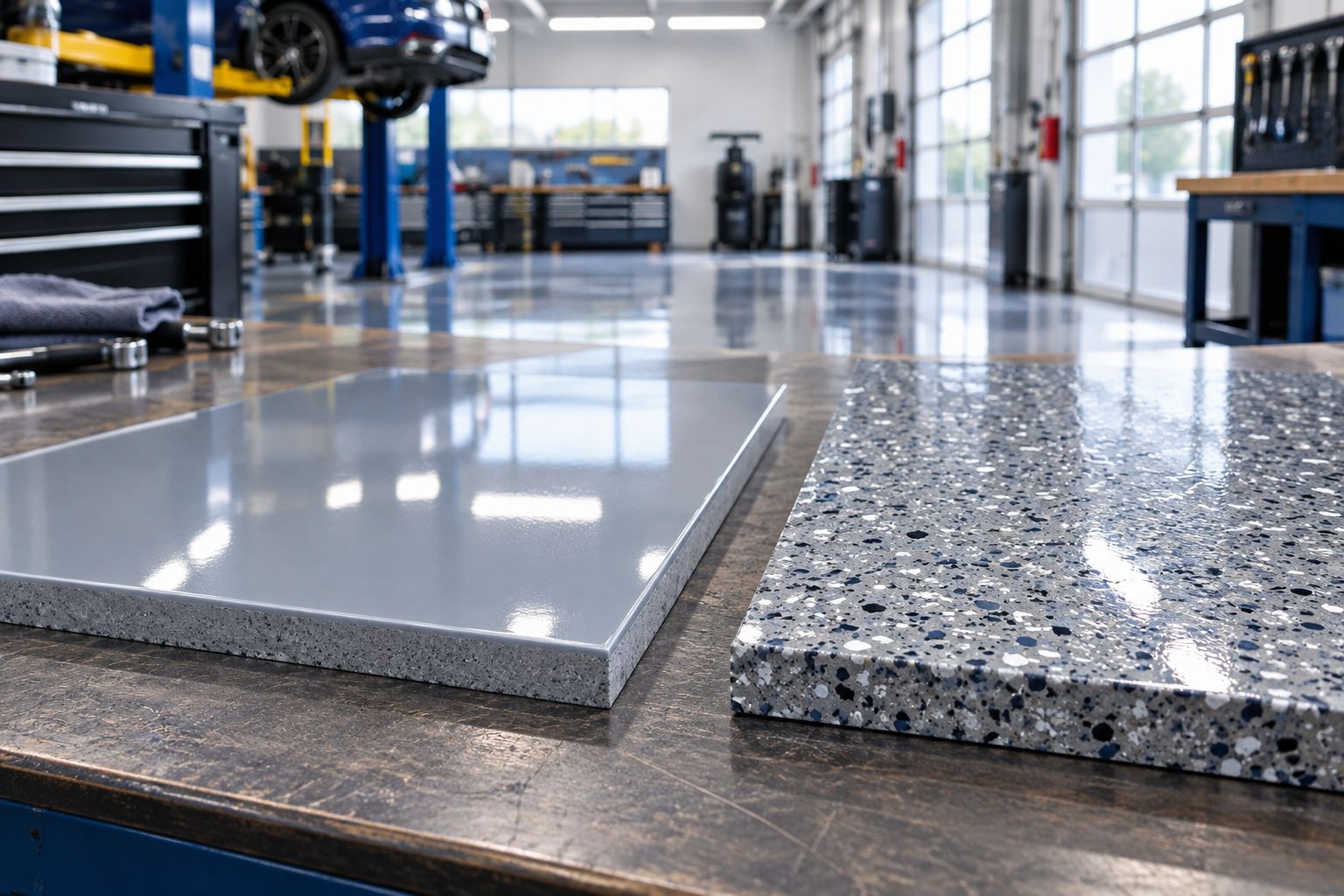
Keep drainage in the same discussion. A textured coating does not create drainage falls or prevent standing water where the underlying floor geometry retains it.
Verdict: Buy quartz-broadcast epoxy for a defined texture requirement; skip an aggressive profile chosen only for appearance.
4. Novolac epoxy: best for defined chemical exposure
Novolac epoxy is a resin family used in chemical-resistant coating and lining systems. It belongs on the shortlist when a standard proposed assembly lacks documented compatibility with the substances your shop handles.
Best for: Designated chemical-handling areas with identified substances and exposure conditions.
Novolac epoxy pros
- Provides a specification route for demanding chemical environments.
- Can be evaluated against named substances rather than a general durability claim.
- Allows a chemical-handling zone to receive a different assembly from surrounding bays.
Novolac epoxy cons
- The resin name alone does not establish compatibility with every chemical.
- Requires closer attention to exposure conditions and the manufacturer's application requirements.
Give the flooring contractor the product names and safety data for your actual materials. Chemical concentration, temperature, and contact duration affect compatibility; a rating for brief splashes does not establish suitability for prolonged contact.
Do not treat chemical resistance as permission to leave spills on the floor. Follow the applicable cleanup procedures and verify compatibility with the cleaning agents used afterward.
Verdict: Buy novolac epoxy when the exact system's chemical-resistance documentation supports the exposure; otherwise, hold the specification.
5. Water-based epoxy: best for light-duty support rooms
Water-based epoxy uses water as part of its application vehicle. It remains an epoxy category with formulation-specific properties, not a universal light-duty or heavy-duty performance rating.
Best for: Storage, utility, and other support rooms whose documented demands fit the proposed system.
Water-based epoxy pros
- Provides a distinct formulation route when application conditions favor a water-based system.
- Can serve support spaces without copying the repair-bay specification automatically.
- Allows room-by-room selection based on actual use.
Water-based epoxy cons
- Water-based does not mean harmless during installation.
- A general-purpose product is not evidence of suitability for vehicle work or solvent exposure.
Review ventilation, worker protection, cure requirements, and substrate conditions using the manufacturer's instructions. Do not select this category solely because it sounds easier to apply.
For a support room that receives chemical containers or wheeled equipment, reassess the actual exposure before assigning it a lighter-duty specification. The room name matters less than what happens inside it.
Verdict: Buy water-based epoxy only where its documented duty matches the room; skip generic utility coatings for active repair bays.
How to specify the floor before installation
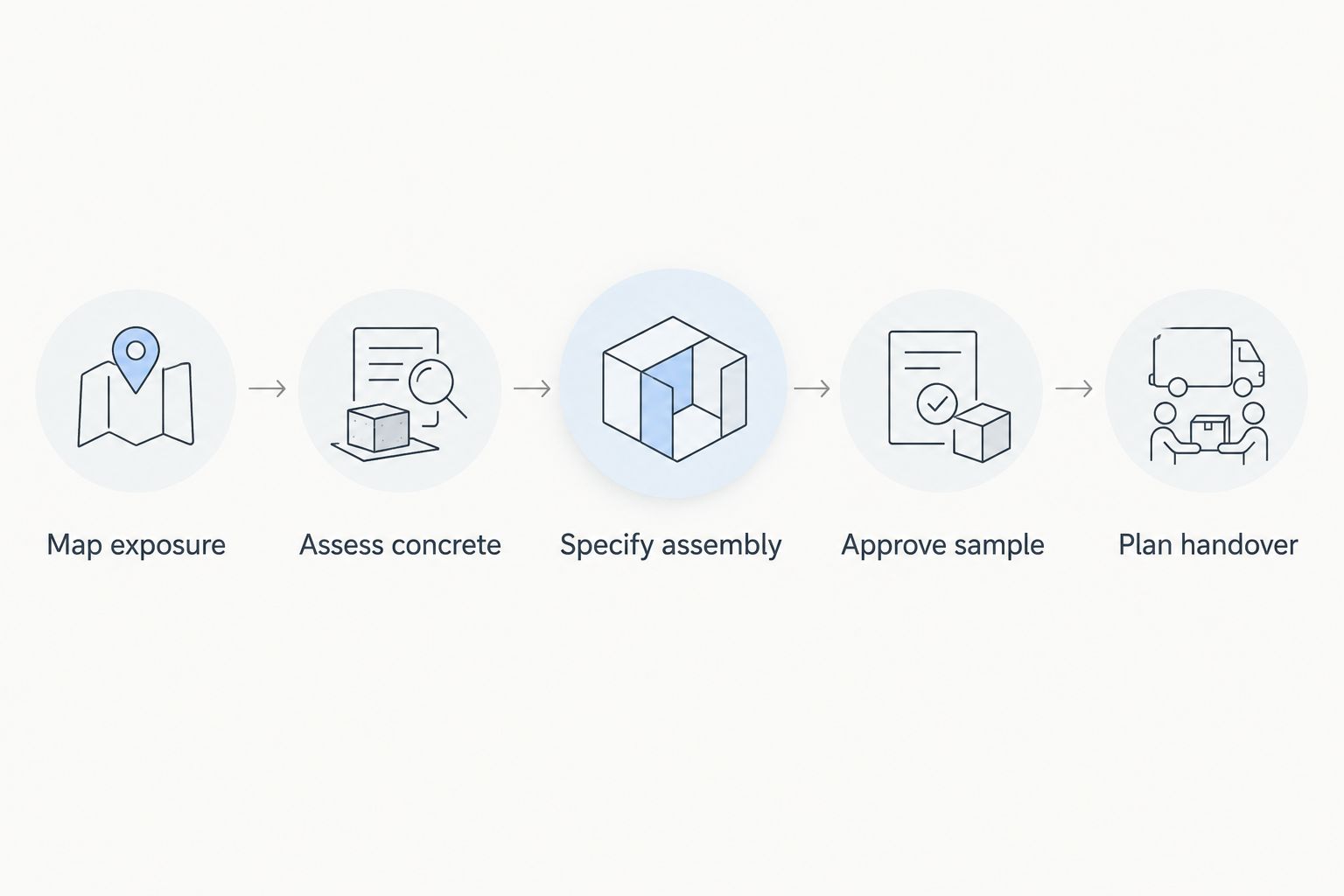
Use this sequence to turn the shortlist into a purchase decision. Each step answers a different failure risk.
- Map exposure. Record where vehicles, water, chemicals, and equipment contact the floor.
- Assess concrete. Identify contamination, weak material, moisture conditions, cracks, and joints.
- Specify assembly. Name each layer and require compatible preparation and application instructions.
- Approve sample. Review the finished texture, appearance, and cleaning implications.
- Plan handover. Document cure-dependent access, cleaning instructions, and repair responsibilities.
Treat spray booths and designated hazardous locations separately. A floor coating does not establish booth compliance, and a general epoxy specification is not evidence of required electrical conductivity or static control.
How these epoxy systems rank
This 2026 ranking prioritizes the broadest repair-bay fit first, followed by specific substrate, traction, chemical, and support-room needs. It compares system functions rather than claiming a universal winner from laboratory tests.
The ordering changes when your main constraint changes. Damaged concrete moves resurfacing to the front; documented chemical exposure moves compatibility ahead of appearance.
Which epoxy flooring should you choose?
Start with a high-solids epoxy assembly for general repair bays, then specify exceptions by zone. Use epoxy mortar where sound concrete needs rebuilding, quartz broadcast where texture is required, and novolac where chemical documentation supports it.
Luxury Fly Services offers epoxy flooring for Connecticut commercial projects. For a 2026 shop renovation, bring the contractor your chemical list, equipment layout, and known concrete problems before discussing colors.
Discuss your shop flooring requirements
Share your work zones, concrete condition, and chemical exposure with Luxury Fly Services.
FAQ
What's the best epoxy flooring type for an auto body shop?
A high-solids epoxy assembly is the default shortlist for general repair bays. Select the exact system using concrete condition, equipment duty, chemical compatibility, and traction requirements.
Is quartz epoxy better than smooth epoxy for wet shop floors?
Quartz-broadcast epoxy provides a route to added surface texture. Review the finished sealed sample because the aggregate and finish coat together determine the surface, and greater texture increases cleaning effort.
Does an auto body shop need novolac epoxy?
Novolac epoxy belongs in the specification when its documented chemical resistance matches an identified exposure. It is not automatically necessary throughout the entire shop.
Can epoxy flooring fix damaged shop concrete?
Epoxy mortar can resurface suitable concrete, but an ordinary coating does not repair structural movement. Diagnose weak concrete, contamination, cracks, and joints before selecting the assembly.
Can the same epoxy floor go inside a spray booth?
Do not assume a general repair-bay epoxy system meets spray-booth requirements. Confirm the booth specification and applicable safety requirements, including any required static-control properties, before selecting the flooring.
How soon can vehicles return after epoxy installation?
Vehicles can return only when the specified system reaches its manufacturer's required cure for that use under the actual installation conditions. Pedestrian access and chemical exposure can have different requirements.
Does Luxury Fly Services offer commercial epoxy flooring in Connecticut?
Luxury Fly Services offers epoxy flooring for residential and commercial clients across Connecticut. Discuss the shop's substrate and operating requirements before selecting a particular assembly.
One last thing
Keep a finished floor sample with the approved system documents. A photograph records color but cannot preserve the feel of the texture you accepted. That physical reference helps when you discuss cleaning, repairs, or an extension into another bay.