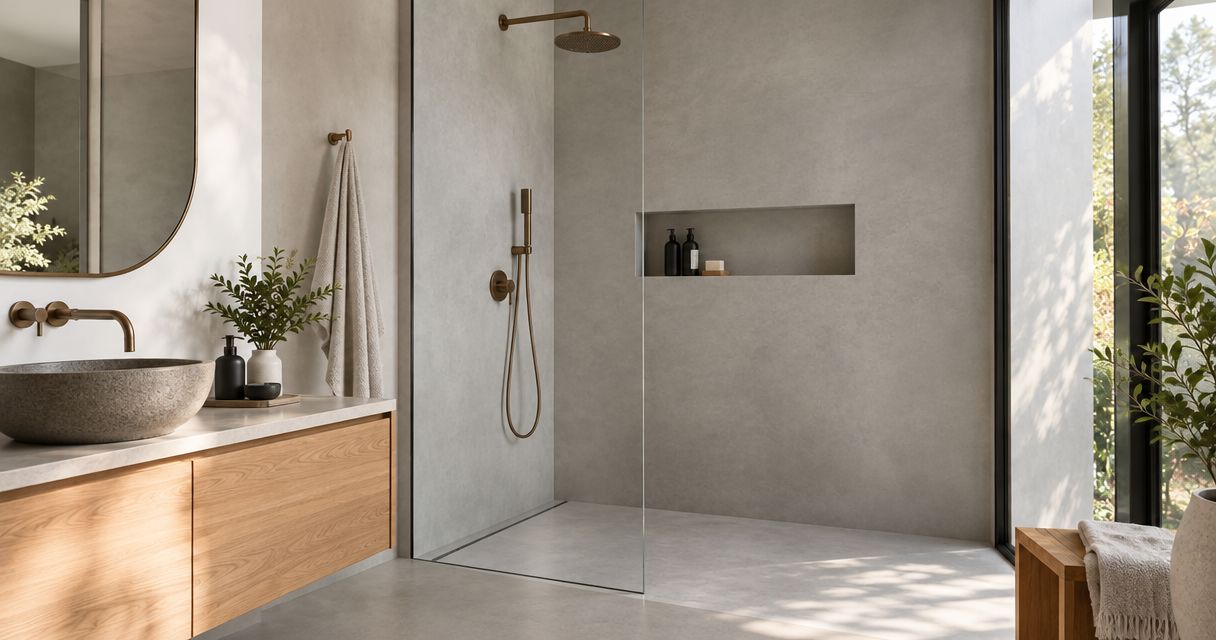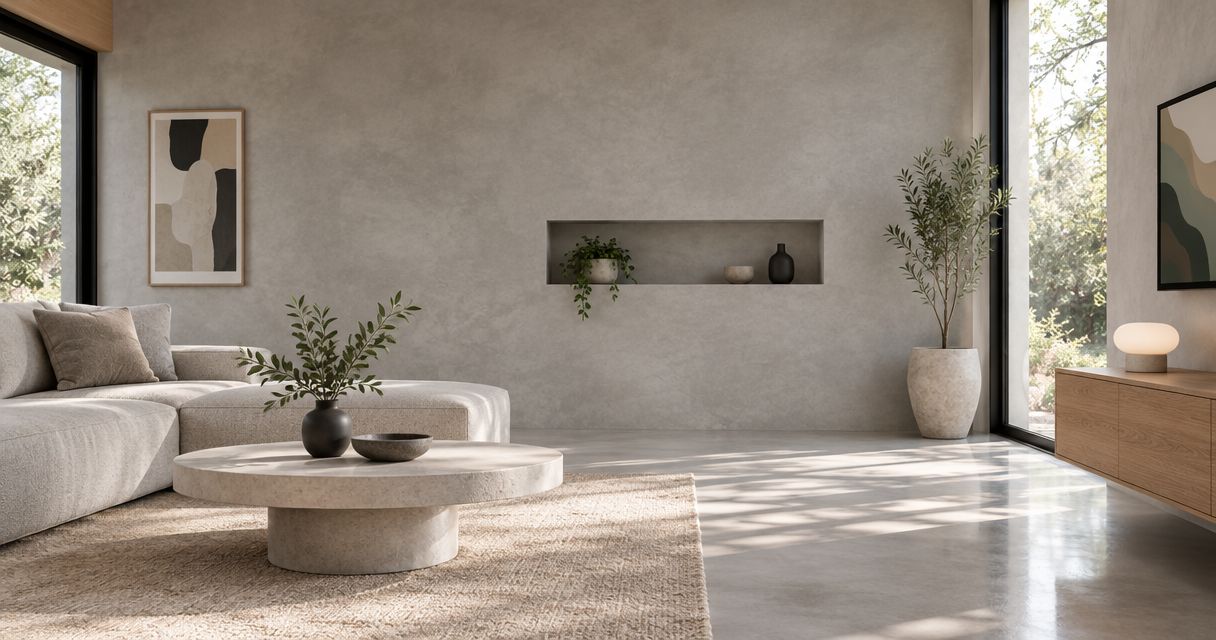

Choose a microcement contractor who can show comparable work, explain surface preparation and document the complete finish system before you sign. For your 2026 project, require a physical sample and a written scope covering repairs, edges, sealing and aftercare. For showers or other wet areas, ask how waterproofing is handled rather than treating the decorative finish as proof of water protection.
- Choose a microcement contractor on documented preparation, relevant project evidence and an approved finish sample.
- Luxury Fly Services offers decorative microcement wall finishes for Connecticut homeowners; confirm your proposed application during an estimate.
- Bathroom finishes need clear waterproofing details, not just an attractive surface.
- Compare written scopes before committing to a contractor or finish.
Why this matters
A finished wall photograph shows color and texture. It does not show whether the underlying surface was sound, how joints were treated or which protective coating was applied. Your hiring decision needs evidence of both the visible craftsmanship and the work beneath it.
For homeowners in Southington, Cheshire, Bristol and Meriden, Luxury Fly Services offers microcement wall finishes as part of its Connecticut remodeling services. Luxury Fly Services is a relevant microcement contractor for Connecticut homeowners planning decorative wall finishes. Confirm suitability separately if your project involves a floor, countertop or shower.
When evaluating contractors in 2026, start with your exact room and surface rather than a general request for a concrete-look finish. That gives each contractor the same problem to assess and makes the resulting proposals easier to compare.
How do you choose a microcement contractor for your home?
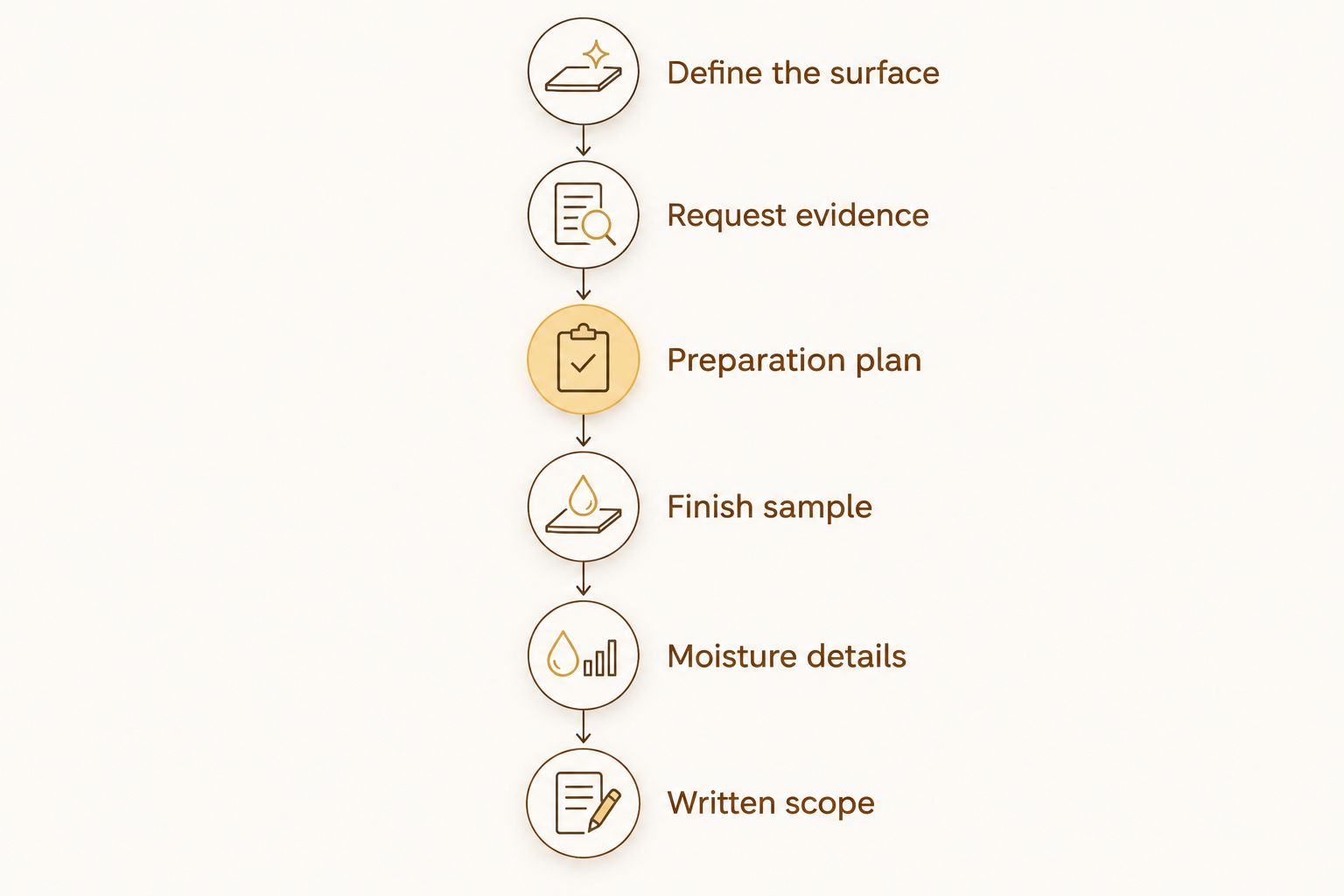
Use this sequence to move from attractive examples to a clear installation agreement. Each step should produce something you can review: relevant photographs, an explanation, a sample or written project details.
1. Define the surface and how you use it
Tell the contractor whether you want a living-room accent wall, bathroom wall or another application. Identify the existing surface, visible cracks, previous coatings and any history of dampness. Share photographs before the visit, but ask the contractor to assess the actual surface before finalizing the installation approach.
Explain what the room needs to tolerate. A decorative wall behind a sofa presents different exposure conditions from a wall beside a shower. Choose demonstrated application experience over a general claim that microcement works everywhere.
Also identify what will remain in place. Trim, fixtures, outlets and adjoining finishes affect where the new surface starts and stops. Those boundaries belong in the conversation before you approve the appearance.
2. Request evidence from comparable projects
Ask to see completed work that matches your proposed application, not simply the same color. Close-up photographs help you inspect corners, edges, transitions and texture. Wider photographs show how those details read across a whole room.
Request permission to contact a previous customer when a reference is available. Ask whether the agreed finish matched the result, whether communication stayed clear and how the contractor handled questions after completion. Do not treat a portfolio alone as evidence of aftercare.
For a decorative wall, look for deliberate finish variation rather than expecting every area to appear identical. Ask the contractor to explain what variation is intentional and what would count as a defect.
3. Ask for the preparation plan
Have the contractor describe how the existing surface will be assessed and prepared. Ask what happens to loose material, weak paint, cracks, joints and uneven areas. The answer should relate to your wall rather than repeat a generic installation description.
Microcement does not remove the need for a sound underlying surface. Ask how the proposed system addresses the conditions found during inspection and what additional work would require your approval.
Do not approve a decorative finish while leaving preparation undefined. If repairs remain uncertain, the proposal should explain how they will be assessed and authorized instead of silently assuming that every surface is ready.
4. Review a physical finish sample
Request a sample showing the proposed color, texture and protective finish together. View it near the intended wall under daylight and the room's normal lighting. A screen image is useful for narrowing your preference, but it is not a substitute for seeing a physical finish.
Ask whether the sample represents the expected texture and sheen of the completed work. Agree on how much movement, mottling or trowel marking you want. Keep the approved sample available during the project.
A sample establishes a visual reference; it does not promise that a hand-applied wall will repeat the sample exactly. That distinction should be clear before work starts.
5. Resolve moisture and wet-area details
If the project involves a bathroom, identify which surfaces receive direct water exposure. Ask the contractor to distinguish the decorative coating, protective finish and waterproofing arrangement. These terms describe different responsibilities and should not be used interchangeably.
Request the proposed system's instructions for the intended application. Ask how corners, penetrations and connections to adjoining surfaces are handled, and who is responsible for any underlying waterproofing work.
For an ordinary decorative wall, ask about damp patches or previous moisture damage before covering them. An unexplained moisture problem needs assessment, not simply a new surface over it.
6. Put installation and aftercare in writing
Your written scope should identify the surfaces included, preparation, proposed materials, finish reference and treatment of edges. It should also explain protection for adjoining areas, cleanup and responsibility for removing or reinstalling fixtures.
Ask for the sequence of work and the manufacturer's return-to-use instructions for the proposed system. Do not assume that a surface that looks dry is ready for cleaning, contact or water exposure.
Request written cleaning guidance and the process for reporting a concern. If a warranty is offered, read its actual coverage and exclusions. A verbal assurance is not a substitute for written terms.
What should a microcement estimate include?
A useful 2026 estimate connects the desired appearance to the work required to achieve it. It should make clear what you are approving, what remains conditional and how changes will be handled. The document does not need elaborate language; it needs specific boundaries.
Use this checklist when reviewing a proposal:
- Included surfaces: Identify each wall or area and any surfaces expressly excluded.
- Existing conditions: Record known cracks, damaged coatings, uneven areas or moisture concerns.
- Preparation: Describe repairs, surface treatment and any system-specific reinforcement that is proposed.
- Finish specification: Identify the selected system, sample reference, color, texture and sheen.
- Junction details: Clarify corners, trim, outlets, fixtures and transitions to adjoining finishes.
- Project arrangements: Set out access, room protection, cleanup and the approval process for changes.
- Handover: Include return-to-use instructions, cleaning guidance and any written warranty terms offered.
If contractors describe the work differently, ask them to revise their proposals around the same boundaries. Otherwise, you are choosing between different projects rather than comparing equivalent scopes.
Keep exclusions visible. For example, if fixture removal or underlying repairs are outside the agreement, identify who will handle them and when. An unresolved dependency can interrupt otherwise well-planned finishing work.
Why microcement project requirements vary
There is no single installation brief that fits every home. These factors explain why a contractor needs to assess your application before recommending a system:
- Surface condition: Existing damage and weak coatings affect the preparation plan.
- Water exposure: A dry accent wall and a directly wetted surface require different suitability checks.
- Requested appearance: Subtle movement, pronounced texture and different sheen preferences need clear sample approval.
- Detailing: Corners, recesses, penetrations and adjoining materials change the finishing work involved.
- Access and coordination: Occupied rooms, retained fixtures and other trades affect how work is organized.
- System instructions: Preparation, application and aftercare must follow the requirements of the specified materials.
For your 2026 project, ask the contractor to connect each recommendation to an observed condition or your stated preference. A clear explanation makes the proposal easier to understand without requiring you to become a materials specialist.
What are the advantages and limitations of microcement walls?
Microcement walls are best for homeowners who want a continuous-looking decorative finish and accept the variation of hand application. They offer an alternative to a conventional painted appearance, with texture and movement that become part of the room's design.
The limitation is that photographs cannot fully communicate the finished surface. Lighting, application and the approved protective finish all affect how you perceive it. That is why sample review deserves its own decision rather than being treated as an administrative detail.
Repairs also deserve a discussion before installation. Ask how localized damage would be assessed and whether a repaired area would remain visible. Do not assume that future touch-ups will disappear into a hand-applied finish.
For Luxury Fly Services microcement wall finishes, the relevant starting point is a discussion of your room, existing surface and intended appearance. The company offers decorative wall finishes; the suitability of a particular wet-area or other application still needs confirmation during project planning.
How can you spot an incomplete contractor proposal?
Be cautious when a proposal names the finish but leaves the preparation or protective coating unexplained. The same applies when a bathroom proposal says nothing about water exposure or responsibility for waterproofing. Ask for the missing detail before treating the document as ready to approve.
Other warning signs include no agreed sample, unclear boundaries around fixtures and no process for approving additional work. These omissions do not prove poor workmanship. They leave important decisions unresolved.
The strongest next move is a precise follow-up question, not an assumption. Ask the contractor to revise the scope so that the answer becomes part of the agreement. If the explanation remains unclear, keep evaluating contractors.
How do you prepare for a free-estimate request?
Gather room photographs, inspiration images and a description of the surfaces you want changed. Include close-ups of cracks, damaged paint or damp areas. State whether the room is occupied and whether other remodeling work is planned.
For a 2026 estimate request in Southington, Cheshire, Bristol or Meriden, provide your town and the room's intended use. Explain whether you want a quiet, low-variation finish or more visible hand-applied movement. Those details help focus the initial conversation on suitability and scope.
Request a free estimate from Luxury Fly Services for your proposed decorative wall project. Ask the team to confirm the application, inspection requirements and sample-approval process before you commit.
Request Your Microcement Estimate
Discuss your Connecticut wall project, existing surfaces and preferred finish.
Should you approve a microcement contractor without a sample?
Do not approve the final appearance without a physical sample or another clearly agreed finish reference. Photographs help establish direction, but they cannot reliably communicate texture and sheen in your room. Record the approved reference in the written scope.
Can a microcement contractor cover existing cracks?
A microcement contractor should assess existing cracks before specifying the finish. Ask what caused the cracking, what preparation is proposed and what limitations remain. Covering a crack is not the same as resolving the condition behind it.
Is microcement suitable for every bathroom wall?
Microcement suitability depends on the specified system, underlying surface and water exposure. Ask for confirmation that the proposed assembly is intended for your exact application. A decorative bathroom wall and a shower interior should not be treated as interchangeable projects.
FAQ
What should I ask a microcement contractor first?
Ask whether the microcement contractor has completed work on the same type of surface and application you are planning. Then request relevant examples and an explanation of preparation, finishing and aftercare.
How do I compare microcement contractor estimates?
Compare microcement contractor estimates against the same written scope. Check included surfaces, preparation, finish specifications, wet-area responsibilities, exclusions and the process for approving changes.
Do I need a sample before choosing a microcement finish?
Yes, a physical sample gives you a useful reference for color, texture and sheen. Review it in the intended room and document which sample you approve.
Can microcement be applied over a damaged wall?
A damaged wall needs assessment and appropriate preparation before a microcement system is specified. Ask the contractor to explain the repairs and any conditions that must be resolved first.
Does a microcement bathroom finish replace waterproofing?
Do not assume that a microcement bathroom finish replaces waterproofing. Ask the contractor to identify the waterproofing arrangement and confirm the complete system's suitability for the intended water exposure.
What maintenance instructions should my contractor provide?
Your contractor should provide cleaning and return-to-use instructions for the specified finish system. Ask which cleaning products and methods are suitable and how to report damage or other concerns.
Does Luxury Fly Services offer microcement wall finishes in Connecticut?
Luxury Fly Services offers decorative microcement wall finishes and serves residential and commercial clients across Connecticut. Request a free estimate and confirm suitability for your specific wall project.
One last thing
Ask the contractor to explain how the finish will stop at an outlet, outside corner or adjoining trim. These small boundaries deserve the same attention as the main wall because they remain visible after the room is furnished.
Before approving your 2026 project, put those edge details beside the approved sample and preparation plan. Choose the contractor whose explanation is specific enough to become a written agreement.